
Atlassian announced usage-based pricing on September 1, and billing starts on December 3, 2026.
Atlassian laid out the reasoning in its usage-based pricing announcement, with the details on the usage-based pricing hub. The key information is below, along with our suggestions on how to prepare.
What is the new Atlassian usage-based pricing model?
Usage-based pricing charges for consumption of specific capabilities rather than for access to them. It sits alongside your existing seat-based subscription rather than replacing it.
The structure works like this:
- Most cloud plans include a monthly allowance for each metered capability, sized against typical usage for that plan and seat count.
- Allowances are pooled across your organization, not split per workspace, per site, or per team.
- Unused allowance does not roll over. Each month starts fresh, so a quiet January doesn’t fund a busy February.
- When you exceed the allowance, you have options: upgrade your plan, move to a collection, buy prepaid usage packs, or continue on pay-as-you-go.
Billing enforcement begins December 3, 2026. Between now and then, metered capabilities run as normal and you can monitor and forecast your consumption inside Atlassian Administration.
What’s being metered in the new model?
Atlassian’s usage-based pricing now covers five meters, mostly related to AI consumption.
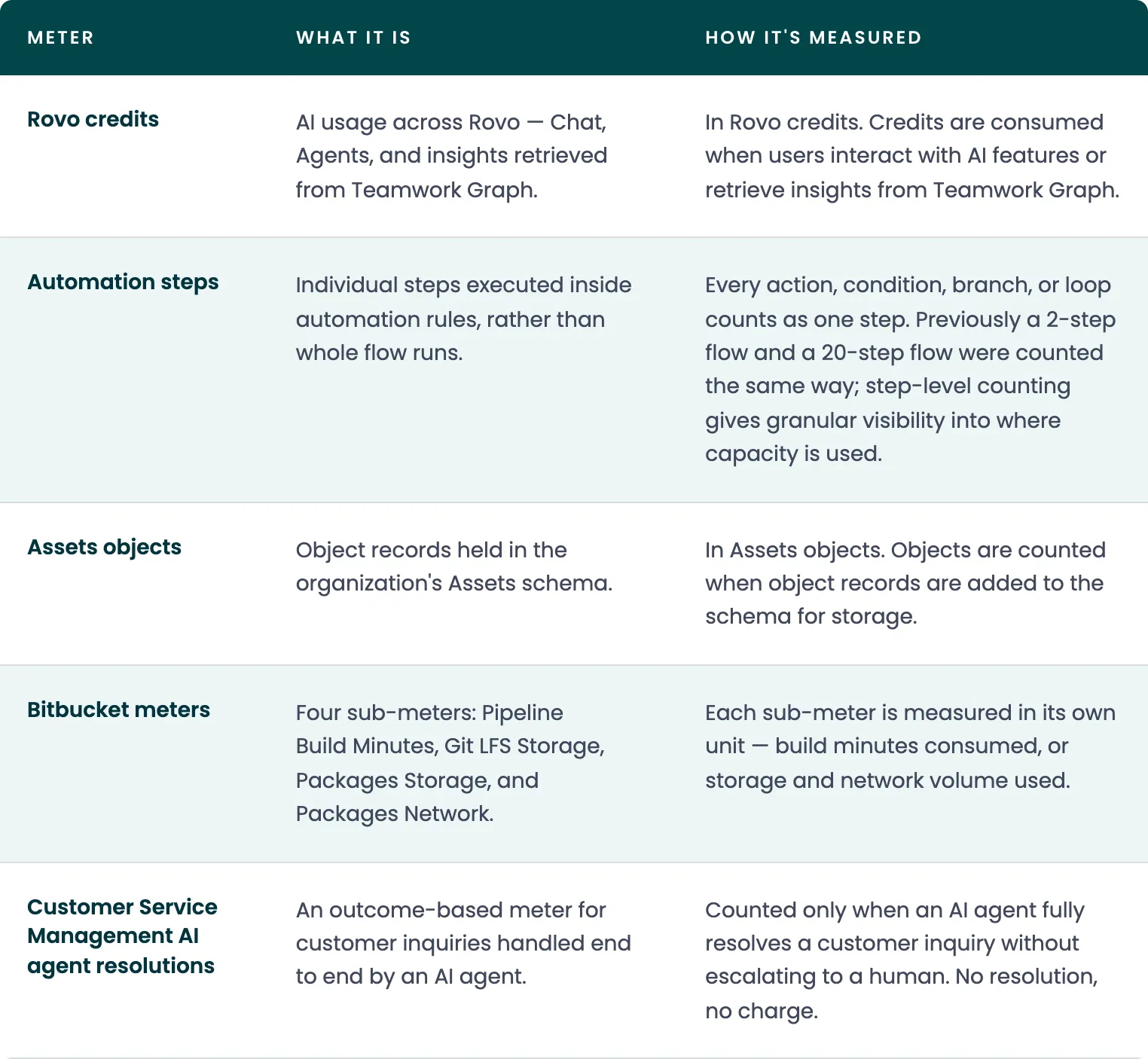
Two details the table doesn’t capture. Rovo credits also cover the Rovo Search API used by tools like the CLI and the MCP server, so programmatic access counts too, and Atlassian’s Rovo usage documentation explains how consumption varies with interaction complexity. Assets allowances now extend to Jira and Teamwork Collection, not just Jira Service Management and Service Collection.
Automation is billed per step, not per run
Previously, a two-step flow and a twenty-step flow counted the same way. Now, every action, condition, branch, and loop counts as one step.
Atlassian’s automation usage documentation explains what counts as a step. One detail worth noting: agentic components like Use Rovo or Use Agent are billed under Rovo credits instead, so they don’t double-count against your automation allowance.
Enterprise no longer means unlimited
Enterprise plans previously included unlimited automation. That changes. All plans now have a defined monthly allowance for automation steps, with Enterprise receiving the highest included allowance.
Bitbucket follows the same pattern: Enterprise moves from unlimited to usage limits.
If your team’s approach is “we’re on Enterprise, automation is free,” you’ll need to reassess before December.
Bitbucket allowances pool at the org level
Bitbucket’s monthly allowances move from the workspace level to the organization level, where they’re pooled.
For most orgs this is neutral or favorable, since a quiet workspace effectively subsidizes a busy one. But if you deliberately separated workspaces to keep build minutes isolated, that isolation is gone. One team’s heavy pipeline month now draws from the same pool as everyone else’s.
How can I monitor and control my organization’s usage?
Alongside the billing change, Atlassian is shipping admin controls in the Platform usage dashboard in Atlassian Administration. Organization and billing admins can:
- See allowances and usage across all five meters in one place.
- Filter Rovo credit usage by app and by individual user, which is how you find out whether consumption is broad adoption or from a handful of power users.
- Forecast expected usage so you can plan ahead rather than reacting to a bill.
- Set extra usage limits to cap spend, adjustable at any time.
- Receive notifications at 80% and 100% of any limit you set.
- Export usage data for internal reporting and reconciliation.
One detail worth noting: metered capabilities keep running uninterrupted up to whatever limit you set. The limit caps your spend, and it’s your call where to set it. Automation doesn’t silently stop working the moment you cross a usage allowance.
What to do before December 3, 2026
You have a window before billing starts. Use it to gather data rather than to guess.
- Baseline your automation step volume. Not run counts, step counts. Identify the rules with the most branches and loops, since those are where the multiplier lives.
- Find your heaviest Rovo users. Filter by user in the platform usage dashboard. If consumption concentrates in a few people, that’s a different conversation than broad organizational adoption.
- Check your Bitbucket workspace assumptions. If you structured workspaces around separate build-minute allowances, re-model against a single pooled org allowance.
- Confirm who your organization and billing admins are. They receive the alerts and control the limits. If that’s a stale list, fix it now rather than after a threshold is crossed.
- Set usage limits and alert thresholds deliberately. Defaults are a starting point, not a decision.
- Look at your Assets object count and consider if you’re running Assets in Jira or Teamwork Collection, where allowances are newly available.
Included allowances are sized for typical usage patterns. If you expect heavier consumption, moving to a collection is worth pricing out: collections include up to 10x higher allowances, along with the predictability of all-in-one pricing.
The logic is that collections cover more apps working together, which means more surfaces where teams use AI and automation, so the allowances scale to match. If you’re already running three or four products separately and expect real Rovo and automation adoption, the math can land differently than it did a year ago. It’s also worth revisiting alongside the October cloud price increase, since both changes affect the collection-versus-point-product calculation.
Need help estimating your next renewal bill?
If you’d like support calculating your next renewal bill for budget forecasting, or if you want help understanding whether a collection now prices out better than your current mix, we can help as an Atlassian Solution Partner.
Take a look at our licensing services or get in touch, and we’ll work through your numbers before usage based billing starts.