
On October 13, 2026, Atlassian’s list prices will increase across the Cloud portfolio.
Atlassian confirmed the change on its Future Pricing page, and customer notifications went out on August 28th. Atlassian also recently announced their usage-based pricing model, which we cover in our guide to Atlassian usage-based pricing.
Which Atlassian Cloud Apps are affected by the price increase?
The change applies to Standard, Premium, and Enterprise plans across Jira, Confluence, Bitbucket, Service Collection, Teamwork Collection, Jira Product Discovery, Atlassian Guard, and Atlassian Government Cloud (FedRAMP).
How much will the Atlassian Cloud price increase be?
The pricing increases range from 3% to 10% depending on product, plan, and seat count. Here is the breakdown.
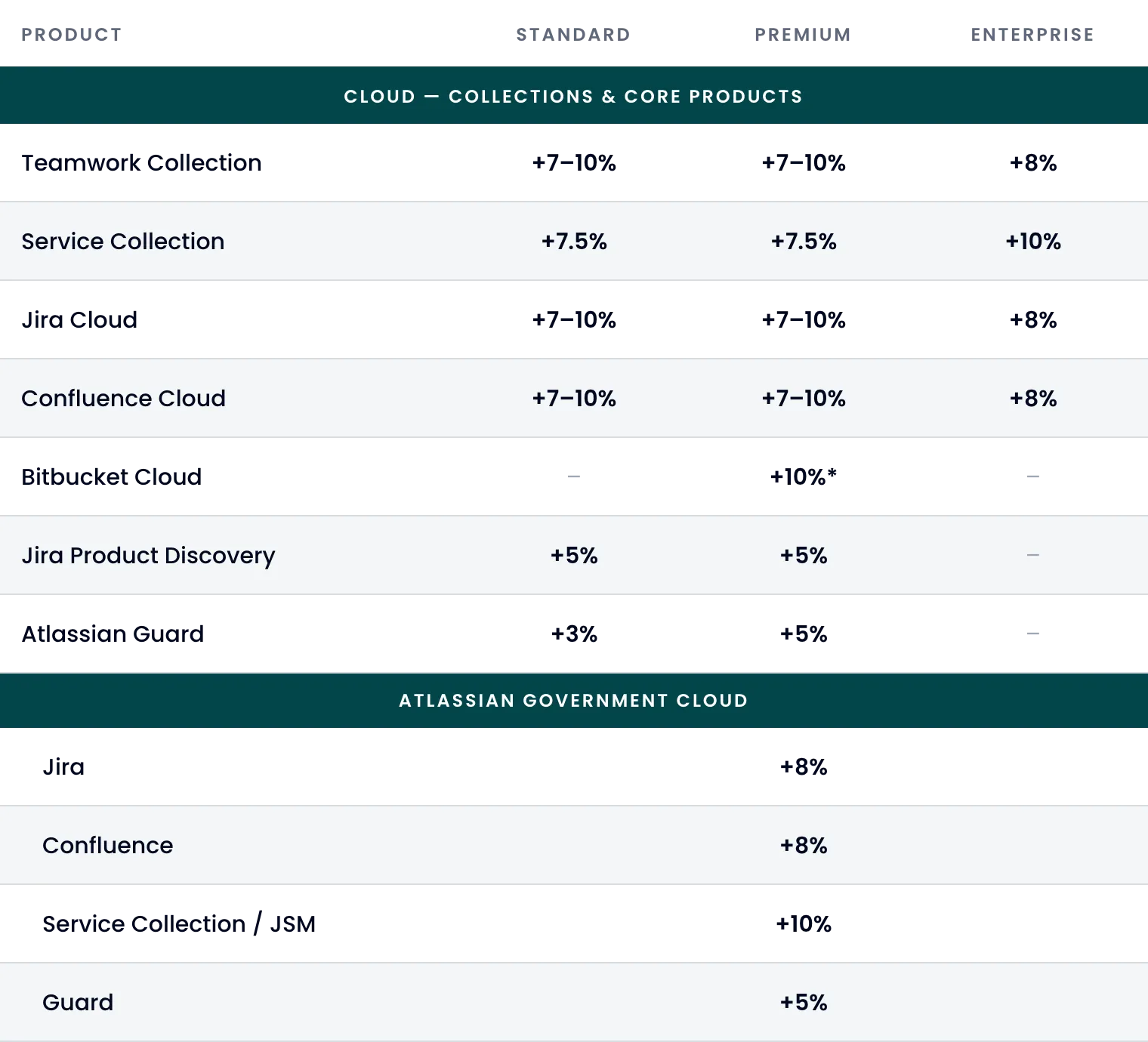
*Bitbucket Cloud Premium no longer has a five-user minimum.
The 7–10% range depends on seat count: subscriptions under 5,000 seats increase by 7%, and subscriptions at 5,000 seats and above increase by 10%.
Japanese yen adjustment
Alongside the list price change, Atlassian is realigning JPY list prices with USD benchmarks across both Cloud apps and Data Center. Atlassian describes this as a 7.3% JPY exchange rate adjustment.
Reasons for the pricing increase
Atlassian ties the increase to platform investment over the past twelve months.
- Teamwork Graph: Atlassian has opened up the context layer through a CLI, a Model Context Protocol server, and a Forge connector, so the graph is reachable from tools outside the Atlassian suite.
- Agents that act: Rovo agents now own tasks and trigger automations in Jira, work with organizational context in Confluence, and can be composed into custom agentic loops in Rovo Studio.
- Enterprise infrastructure: An expanded compliance footprint, new tiers for scale, and additional observability features.
- Service Collection: The bundling of Jira Service Management, Assets, and the new Customer Service Management app into a single collection.
The honest read: if your teams are actively using Rovo and agentic automation, the investment story lines up with what you’re getting. If you’re running Jira and Confluence as straightforward work-tracking tools with AI switched off, you’re absorbing an increase funded by capabilities you aren’t using yet. That gap is the real conversation to have internally, and it’s the argument for either adopting more of the platform or right-sizing what you’re paying for.
How to plan for the Atlassian cloud price increase
Four things are worth doing before your next renewal cycle:
- Recalculate your bill: Apply the right percentage to each product and plan you purchase. The spread between Guard at 3% and Enterprise JSM at 10% is wide enough that averaging will mislead your budget.
- Audit inactive seats: A percentage increase applied to seats nobody uses anymore is the most avoidable cost in the portfolio. Deactivated users, contractors who rolled off, and duplicate accounts all get repriced along with everyone else.
- Check the 5,000-seat threshold: If you are near it on Jira, Confluence, or Teamwork Collection, know which side of the line you land on and what that does to your number.
- Model collections against point products: If you own three or four products separately, a collection may price out better after the increase than it did before.
Get a second set of eyes on your licensing
If you want help modeling what the Atlassian cloud price increase does to your specific footprint, including checking whether a collection now beats your current mix, or right-sizing what you own before next renewal, that’s the kind of thing we do every week as an Atlassian Solution Partner.
Take a look at our licensing services or get in touch, and we’ll walk through your renewal options with you.