

In today’s digital-first environment, internal operations are becoming just as important as customer-facing processes. While IT departments have long relied on robust systems to manage service delivery, other departments—like HR, Finance, Legal, and Facilities—often lag behind, still relying on spreadsheets, emails, and manual workflows. That’s where Enterprise Service Management (ESM) steps in.
This article explores what enterprise service management is, how it works, and why it matters for your business.
What is Enterprise Service Management?
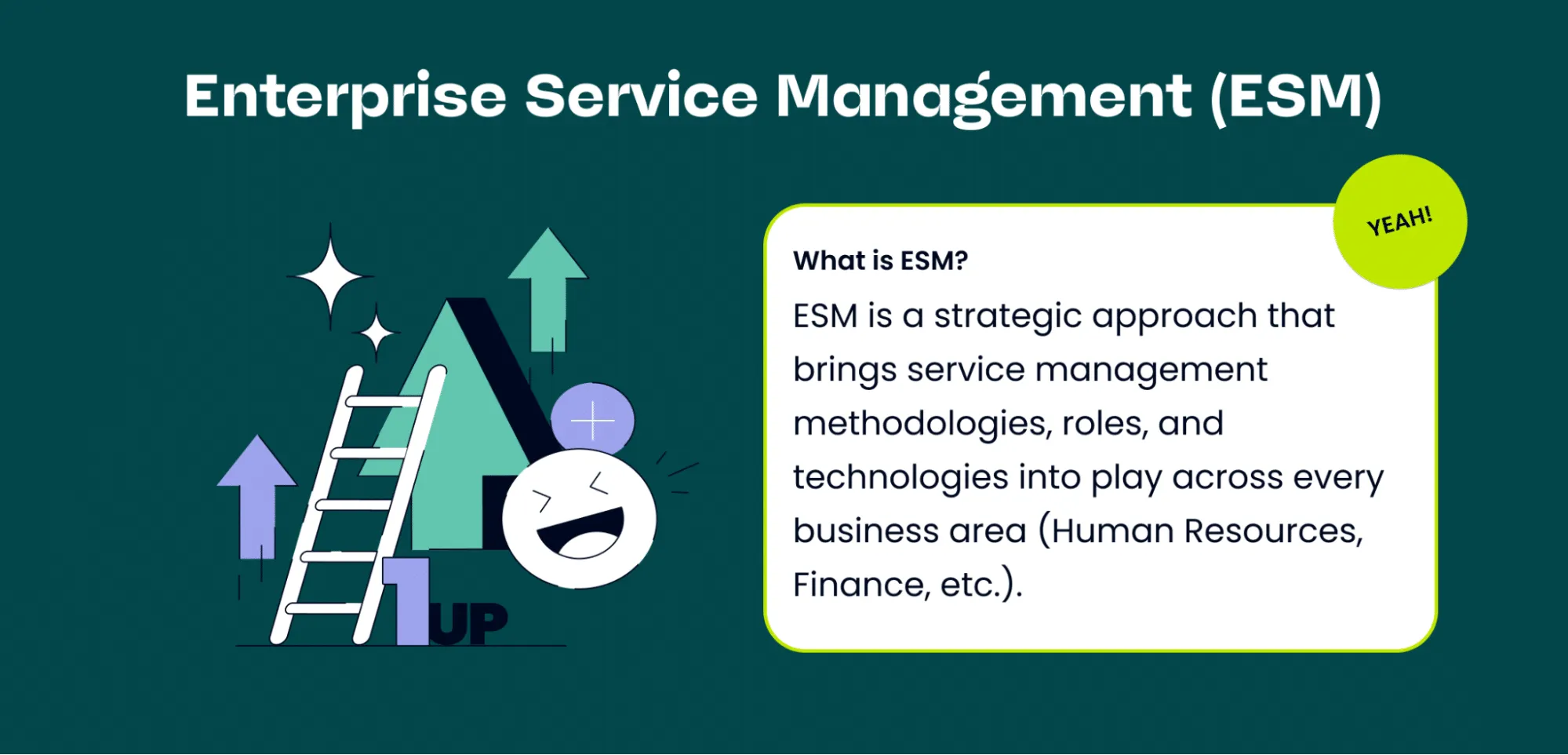
Enterprise Service Management (ESM) is a holistic approach that extends the principles, tools, and best practices of IT Service Management (ITSM) across an entire organization.
In simple terms, it means using the same frameworks that make IT departments efficient—like service desks, ticketing systems, automation, and self-service portals—for other teams in the company. You can find a full breakdown of ITSM vs. ESM here.
Instead of being limited to IT, ESM enables departments like HR, Facilities, Legal, Finance, Procurement, and more to manage and deliver their internal services in a standardized, efficient, and transparent way.
Think of ESM as taking what already works in IT and scaling it across your entire organization to break down silos and provide better internal services.
Benefits of Enterprise Service Management
Across business functions, every department has “customers” to serve—whether they’re employees, vendors, or external partners. These internal customers rely on consistent, timely service. However, traditional methods (emails, forms that don’t sync with other databases, or siloed tools) often result in delays, frustration, and inefficiency.
The main motivation for adopting ESM is simple: better service, delivered more efficiently. Here are a few of the benefits ESM provides to business teams.
1. Improved Collaboration Across Departments
One of the most significant advantages of ESM is the elimination of departmental silos. Each department uses its own set of tools, processes, and communication methods in many organizations. This fragmentation leads to inefficiencies, miscommunication, and delayed service delivery.
By adopting a unified enterprise service platform, teams can collaborate on a single system of record. ESM creates standardized workflows and shared data that ensure everyone is on the same page, regardless of their department. This collaborative approach can lead to faster resolution, delivery, and performance.
2. Increased Efficiency Through Automation and Standardization
Manual processes are time-consuming, error-prone, and expensive. ESM replaces these outdated methods with automated workflows and standardized processes that reduce redundancy and speed up service delivery.
When departments use an enterprise service platform, they can automate tasks like:
- Request approvals
- Incident resolution
- Equipment provisioning
- Access rights management
- Employee onboarding and offboarding
This automation leads to faster resolution times, reduced human error, and less time spent on routine administrative work.
3. Enhanced Employee Experience
Employees expect fast, intuitive, and consumer-like service experiences at work. Unfortunately, many internal services are still clunky, inconsistent, and slow to respond.
Enterprise Service Management (ESM) changes that. It ensures internal employees receive the same seamless service experience they expect as external customers, especially when interacting with traditionally employee-facing departments like IT or HR. ESM empowers employees to quickly find solutions to their problems by offering user-friendly self-service portals, knowledge bases, and automated workflows.
A positive employee experience is directly linked to better retention rates and performance. When employees have the tools and support they need, they’re more likely to stay engaged and contribute meaningfully.
4. Reduced Operational Costs
Cost efficiency is always a priority, and ESM delivers. By automating workflows, eliminating redundancies, and optimizing resource usage, ESM helps organizations cut costs without sacrificing quality.
Some of the key areas where ESM reduces costs include:
- Labor costs: Less time spent on manual tasks
- IT and software spend: Consolidated platforms reduce the need for multiple tools
- Error reduction: Standardized processes minimize costly mistakes
- Time savings: Faster service delivery saves hours across departments
These savings quickly add up, improving your bottom line while maintaining high service quality.
5. Better Visibility into Service Performance
You can’t improve what you can’t measure. ESM with tools like Jira Service Management and Confluence provides real-time dashboards, reports, and analytics that offer insights into service demand, performance, wiki usage, and user satisfaction.
Managers and department heads can easily track:
- Request volumes and resolution times
- SLA compliance
- Bottlenecks in workflows
- Resource allocation
- Wiki page views and comments
This visibility enables data-driven decision-making, continuous improvement, and proactive service management.
6. Scalable and Adaptable Framework
One of the underrated enterprise service management benefits is scalability. Whether your organization has 50 or 5,000 employees, ESM systems can scale to meet evolving demands.
Because ESM is built on modular platforms, you can start with one department—often IT or HR—and expand gradually to include others like finance, legal, or procurement.
As your business grows, your ESM framework can adapt—incorporating new workflows, users, and service offerings without needing an overhaul. Plus, teams only need to learn one platform’s interface - making user adoption easier.
7. Governance, Compliance, and Risk Management
Modern businesses must navigate a complex landscape of regulations, privacy concerns, and security threats. ESM helps enforce consistent governance and compliance practices across all service functions.
By centralizing service delivery and documentation, ESM ensures:
- Standardized approval processes
- Secure access controls
- Audit trails and record-keeping
- Policy enforcement across departments
This reduces organizational risk and simplifies audits, especially in heavily regulated industries like healthcare, finance, and government.
Real-World Use Cases of ESM
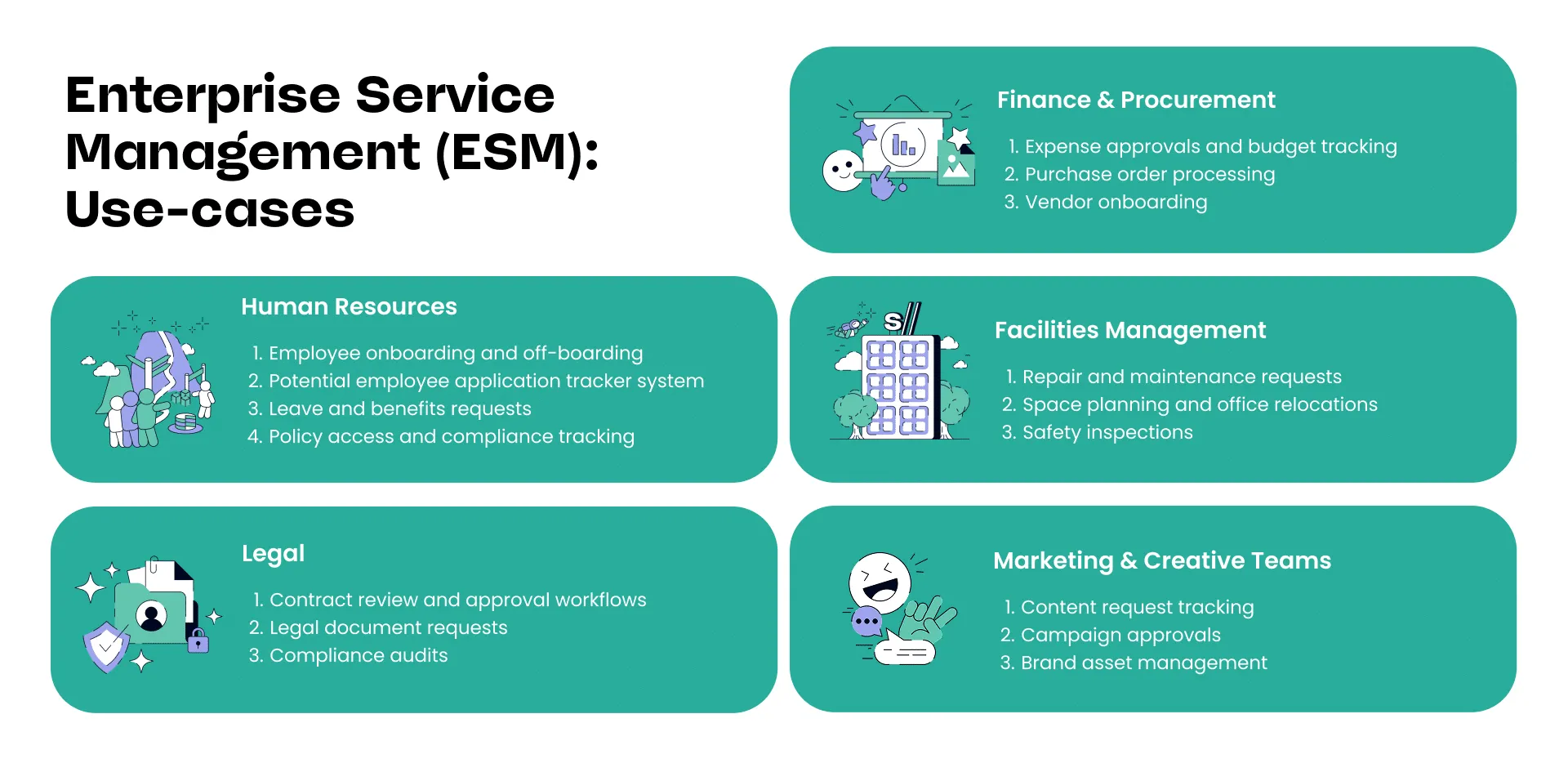
ESM isn’t theoretical—it’s already transforming how teams work in many organizations. Here are just a few departments that benefit from ESM tools like Jira Service Management:
Human Resources (HR) Onboarding
According to research, 69% of employees are likely to stay with a company for at least 3 years after a great onboarding experience (source: Webmd).
Imagine a new hire—let’s call him Bob—joining your organization. In a traditional setup, Bob’s first week might involve a confusing mix of emails, manual requests, and repeated follow-ups to get the basics: a laptop, building access, email credentials, and mandatory training.
Now, enter Enterprise Service Management.
With a unified service management platform, HR, IT, Facilities, and other departments can coordinate effortlessly. A single automated workflow kicks in as soon as HR initiates Bob’s onboarding. Bob is issued his laptop, granted access to the building, enrolled in training, and set up with all necessary accounts, without anyone chasing tickets or juggling spreadsheets.
The result? Bob hits the ground running, and internal teams save time, reduce errors, and avoid the usual onboarding chaos. It’s a smoother start for Bob and a more efficient process for everyone else—a win-win.
Other HR related tasks that can benefit from ESM include:
- Prospective employee application tracker system
- Leave and benefits requests
- Policy access and compliance tracking

Legal Contract Approvals
Let’s see another example - enter our sales leader, Sophie. She just finalized a major deal with an important business client. But to seal the deal, her contract needs legal approval. In a traditional setup, this could take days, bogged down by email threads, unclear ownership, and manual handoffs. Substandard contracting processes can cost companies anywhere from 5–40% of the value of a given deal (source: Thoughtriver). That’s not just a legal delay—it’s a missed business opportunity.
How can ESM help Sophie prevent this loss? Sophie submits her contract via a centralized portal. Instantly, an automated approval workflow is triggered:
- The contract is routed to the appropriate legal approver based on predefined rules (deal size, type, risk level).
- All stakeholders are notified automatically.
- No one’s chasing signatures—reminders and escalations are built in.
The legal team focuses on legal review, not logistics. The contract is approved quickly, and Sophie’s deal closes on time, protecting the full value of the agreement. The Result? Instead of losing up to 40% of the deal’s value due to delays or errors, the company captures its full potential. Legal becomes a driver of business, not a bottleneck. With ESM, better workflows don’t just save time—they protect revenue.
Other legal-related tasks that can benefit from ESM include:
- Legal document requests
- Compliance audits
Marketing & Creative Teams
According to a McKinsey Global Institute study, employees spend only 39% of their time on role-specific tasks. The other 61% goes toward emails, searching for files, and coordinating with colleagues (source: McKinsey).
For marketing and creative teams, that means less time designing, writing, and building campaigns, and more time playing project manager.
Now let’s see how ESM can help Elena. She’s a marketing manager who needs a campaign landing page and accompanying assets in two weeks. In the old setup, she emails the creative team with a request. The details are vague. The designer isn’t sure about the specs. The copywriter is working from an outdated brief. And when Elena follows up, no one knows where the request stands.
With ESM, Elena submits her request through a centralized portal. The intake form is smart, prompting for target audience, asset types, deadlines, and messaging. All the details are captured up front.
Then:
- The request is automatically routed to the right creative leads.
- Tasks are tracked with full transparency—status, assignee, due dates.
- No chasing updates or duplicate requests.
The Result? Designers and copywriters stop digging through emails and start doing what they’re hired to do: create. Elena gets her campaign on time, with fewer revisions. And the team reclaims hours once lost to admin chaos. With ESM, content request tracking becomes seamless, freeing up time, reducing frustration, and helping marketing teams focus on strategy and creativity.
Other marketing-related tasks that can benefit from ESM include:
- Campaign approvals
- Brand asset management
Who Should Consider ESM?
Not sure if ESM is worth the hassle of implementing in your organization? Good candidates for ESM adoption include teams that:
- Receive frequent or high-volume service requests
- Must track approvals or escalate requests
- Handle standardized, time-sensitive workflows
- Need to report on service performance or request metrics (SLAs)
Often, starting with HR or Facilities provides a strong foundation for ESM rollout, as these departments are service-heavy and ripe for efficiency gains.
Understanding what enterprise service management is and embracing its value can be a game-changer for your business. By applying proven IT service principles across the entire organization, ESM delivers measurable benefits—from faster service delivery and lower costs to a better experience for every internal customer.
In a world where agility and efficiency are key to survival, enterprise service management is not just a trend—it’s a strategic imperative.
Ready to Bring ESM to Your Business?
At Seibert Solutions, we help organizations unlock the full potential of ESM by implementing scalable, user-friendly platforms like Jira Service Management. Whether you’re looking to streamline HR onboarding, manage legal approvals, or unify internal service requests across departments, our team can help you design and deploy an ESM solution tailored to your needs.
Contact Seibert today to discover how we can help you optimize internal services, improve employee satisfaction, and reduce operational complexity with enterprise service management.