

ServiceNow vs. Jira Service Management
Choosing the right IT service management (ITSM) tool can make or break your organization’s ability to deliver reliable, cost-effective, and user-friendly services. While ServiceNow has long been seen as a leader in the space, many IT leaders are realizing that its complexity, high costs, and heavy implementation demands outweigh its benefits. Enter Jira Service Management (JSM) - Atlassian’s modern, agile approach to service management. JSM has gained traction as a lightweight yet powerful alternative that empowers IT, Dev, and business teams with a lower total cost of ownership (TCO). In this article, we’ll compare Jira Service Management and ServiceNow across eight key categories: pricing, upgrades, renewals, ITIL practices, implementation, enterprise service management, platform connectivity, and AI capabilities. By the end, you’ll know which platform better fits your organization’s needs.
What is ServiceNow and Jira Service Management?
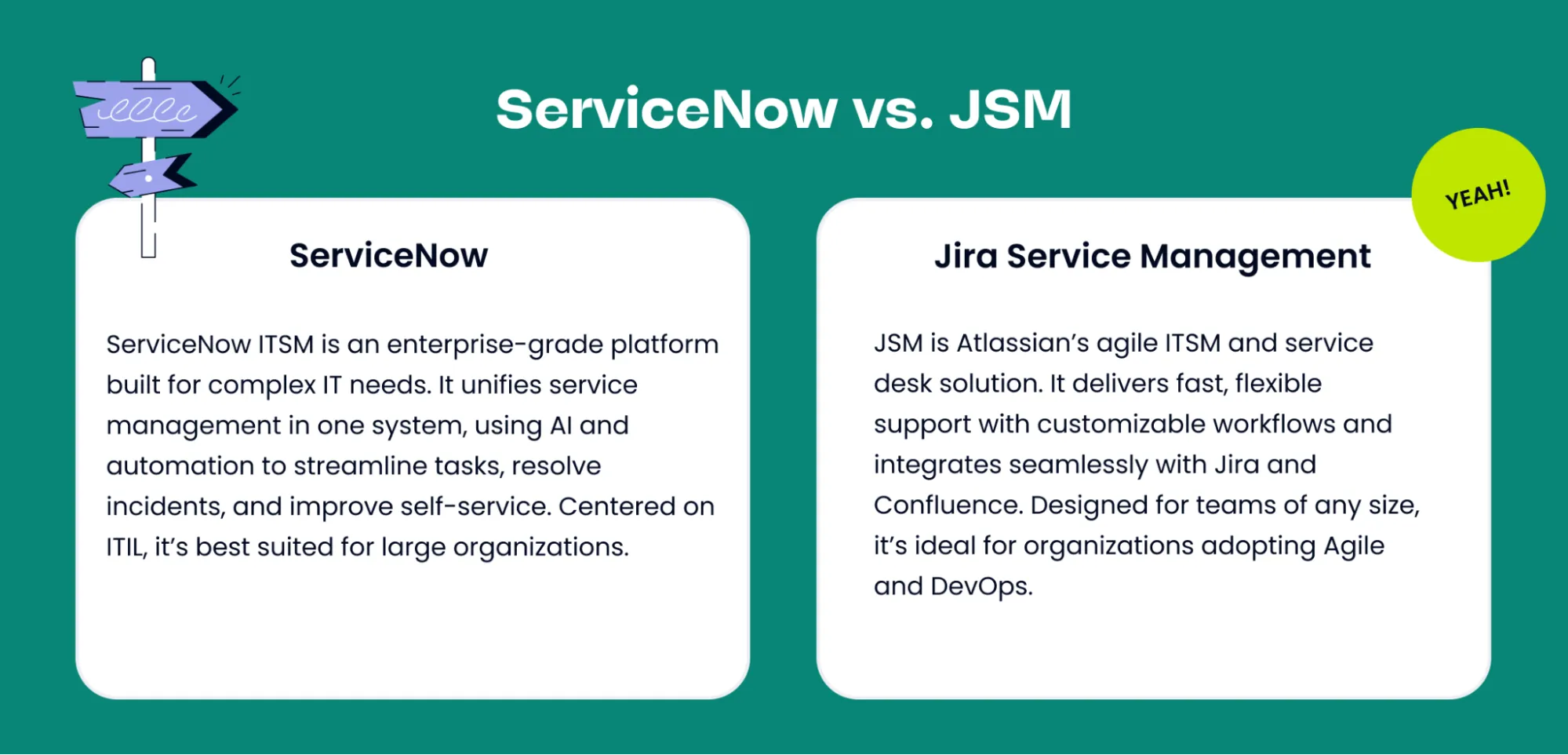
To understand the differences between ServiceNow and Jira Service Management, it’s important to first define what they are. ServiceNow is a cloud-based IT Service Management (ITSM) platform that automates, streamlines, and optimizes IT services across an organization. It provides a centralized system for incident, problem, change, and asset management, enabling IT teams to deliver faster and more consistent support. Jira Service Management, on the other hand, is Atlassian’s ITSM solution that connects development, IT, and business teams through collaborative workflows. Built on Jira, it allows organizations to manage incidents, requests, changes, and assets while integrating seamlessly with agile and DevOps processes. With a clear understanding of what each platform offers, we can now dive into how they differ across key areas—starting with pricing and packaging.
Deep Dive: How Jira Service Management Compares to ServiceNow
1. Pricing & Packaging
-
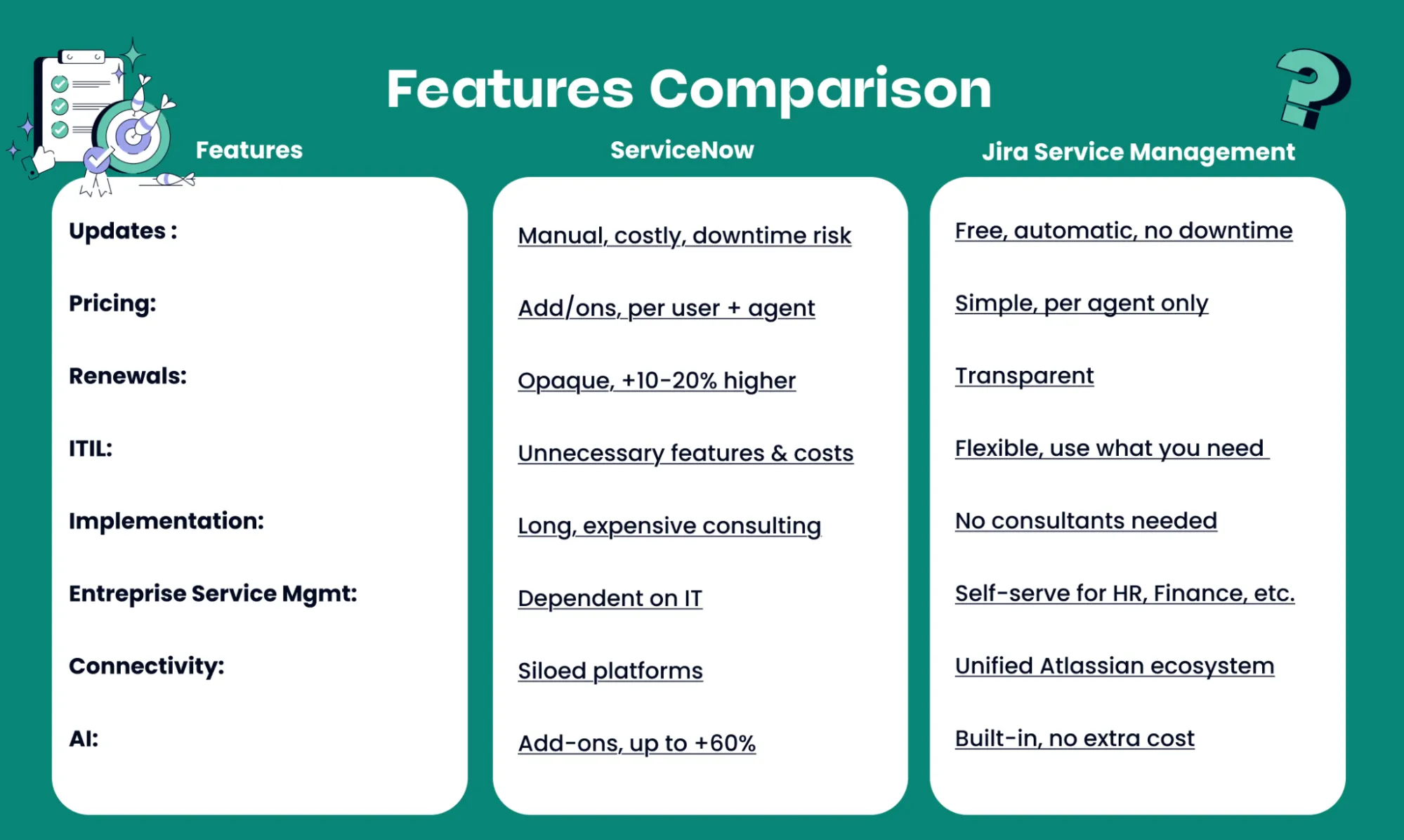
Jira Service Management uses a simple, transparent model. Organizations are billed per agent only, with no extra cost for help-seekers. AI, non-IT workflows, and automation are included in the core product, reducing surprises.
-
ServiceNow, by contrast, has a reputation for opaque and unpredictable pricing. Customers often encounter frequent repackaging, unexpected add-ons, and charges for both agents and business users. Scaling beyond IT requires purchasing numerous SKUs and modules, driving up costs.
2. Software Upgrades
-
Jira Service Management customers benefit from automatic Cloud upgrades—free, seamless, and with no downtime. Teams always have access to the latest features.
-
ServiceNow requires manual, bi-annual upgrades. These not only consume time and labor but also risk downtime if not carefully planned, leading to added disruption and cost.
3. Renewals
-
Atlassian offers transparent renewals with no hidden fees or surprises, making budgeting predictable.
-
ServiceNow customers often face black-box renewals that require 12–24 months of planning to avoid spikes of 10–20% in costs. (Source: Gartner, 2024)
4. ITIL Practices
-
JSM takes a modern approach to ITIL, allowing teams to select only the practices they need. This prevents feature bloat and keeps systems lean.
-
ServiceNow pushes a more feature-heavy approach, often adding unnecessary complexity and storage costs for functions teams don’t actually use.
5. Implementation
-
Jira Service Management is quick to deploy. It balances out-of-the-box configuration with deep customization, and customers can get started without relying on costly consultants.
-
ServiceNow implementations are notorious for being slow, expensive, and consultant-heavy, often taking many months to get up and running—slowing time-to-value.
6. Enterprise Service Management
-
With JSM, non-IT teams like HR, finance, and facilities can easily launch their own service portals using pre-built templates and AI-powered setup tools. These stay aligned with the larger organization without IT bottlenecks.
-
In ServiceNow, business teams depend on IT to configure and maintain their service desks, creating delays, complexity, and higher licensing costs.
7. Platform & Connectivity
-
Atlassian’s ecosystem connects Dev, IT Ops, and business teams in one shared system of work. This accelerates workflows such as incident response and change management by providing visibility across the lifecycle.
-
ServiceNow operates more in silos, especially between Dev and Ops, which can lead to gaps in visibility and delayed incident resolution.
8. Artificial Intelligence
-
Jira Service Management Premium and Enterprise editions include generative AI features like virtual agents, ticket triage, summaries, and AIOps—at no extra cost. Atlassian Intelligence leverages 20+ years of workflow data for accurate, practical results.
-
ServiceNow offers comparable AI through its Now Assist modules, but these require separate per-seat purchases, adding as much as 60% more cost per module. (Source: Forbes, 2023)
Which Platform Is Best for Your Organization?
-
Choose Jira Service Management if… you want fast implementation, transparent pricing, enterprise-grade AI included, and flexibility for both IT and business teams. JSM is particularly attractive for organizations seeking a lower TCO and faster ROI.
-
Stick with ServiceNow if… you have the budget, staffing, and need for a highly complex ITSM deployment that can justify higher costs and longer timelines.
Work with an Atlassian Partner
Navigating ITSM options can feel overwhelming, but you don’t have to do it alone. An Atlassian Solution Partner can help assess your organization’s ITSM requirements, tailor Jira Service Management to your specific workflows, optimize licensing to control costs, and support a smooth migration from ServiceNow.