
Effective service management is more critical than ever in today’s complex business environment. Yet many organizations struggle to distinguish between IT Service Management (ITSM) and Enterprise Service Management (ESM). Are there different approaches? Is one replacing the other?
This article clarifies the confusion around ITSM vs ESM, explains how they’re related, and explores how businesses can leverage both to deliver standardized, efficient services across the enterprise.
What Is ITSM (IT Service Management)?
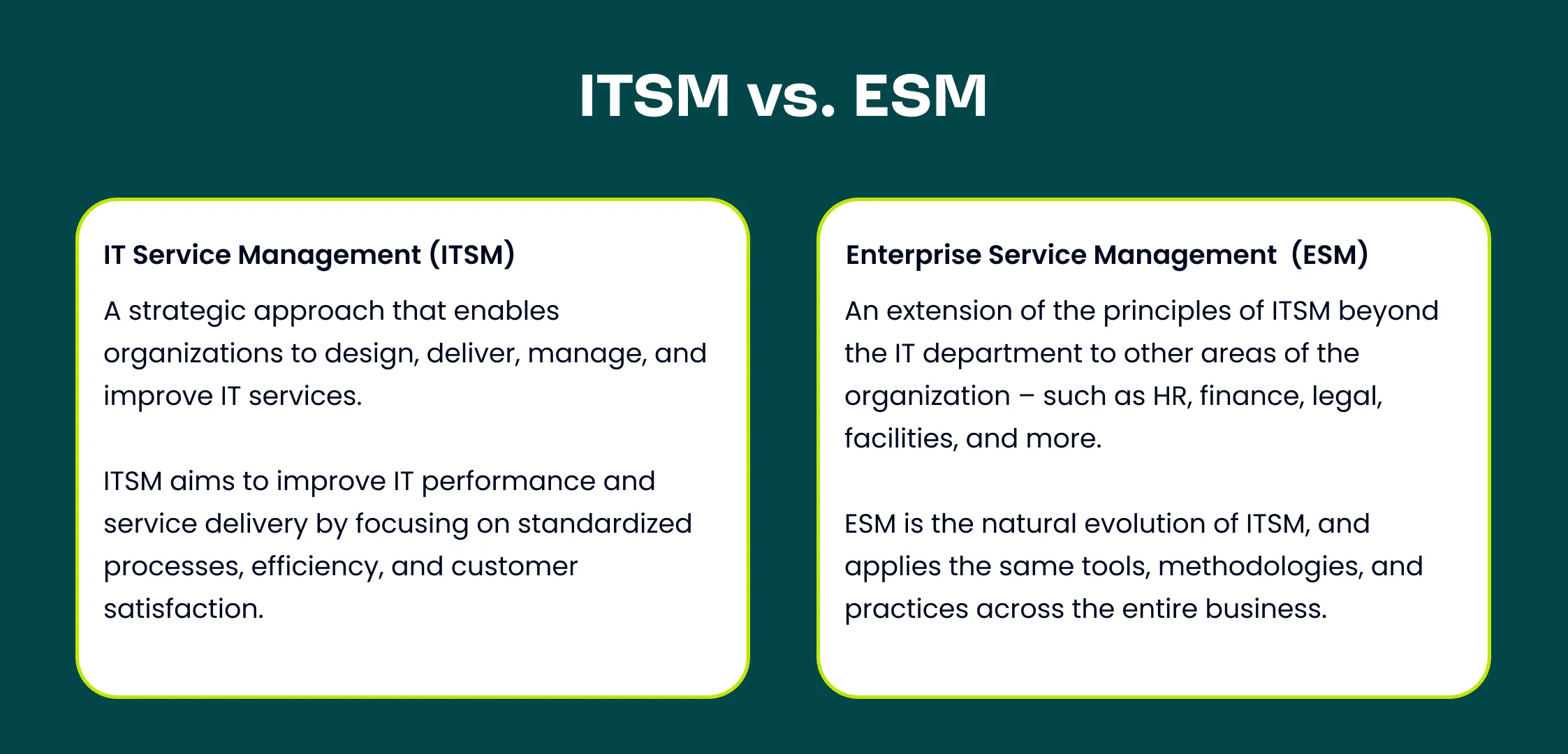
ITSM stands for IT Service Management (ITSM), a strategic approach that enables organizations to design, deliver, manage, and improve IT services. Rather than just managing IT infrastructure, ITSM focuses on aligning IT services with business needs, helping teams deliver better customer outcomes.
ITSM Meaning and Core Goals
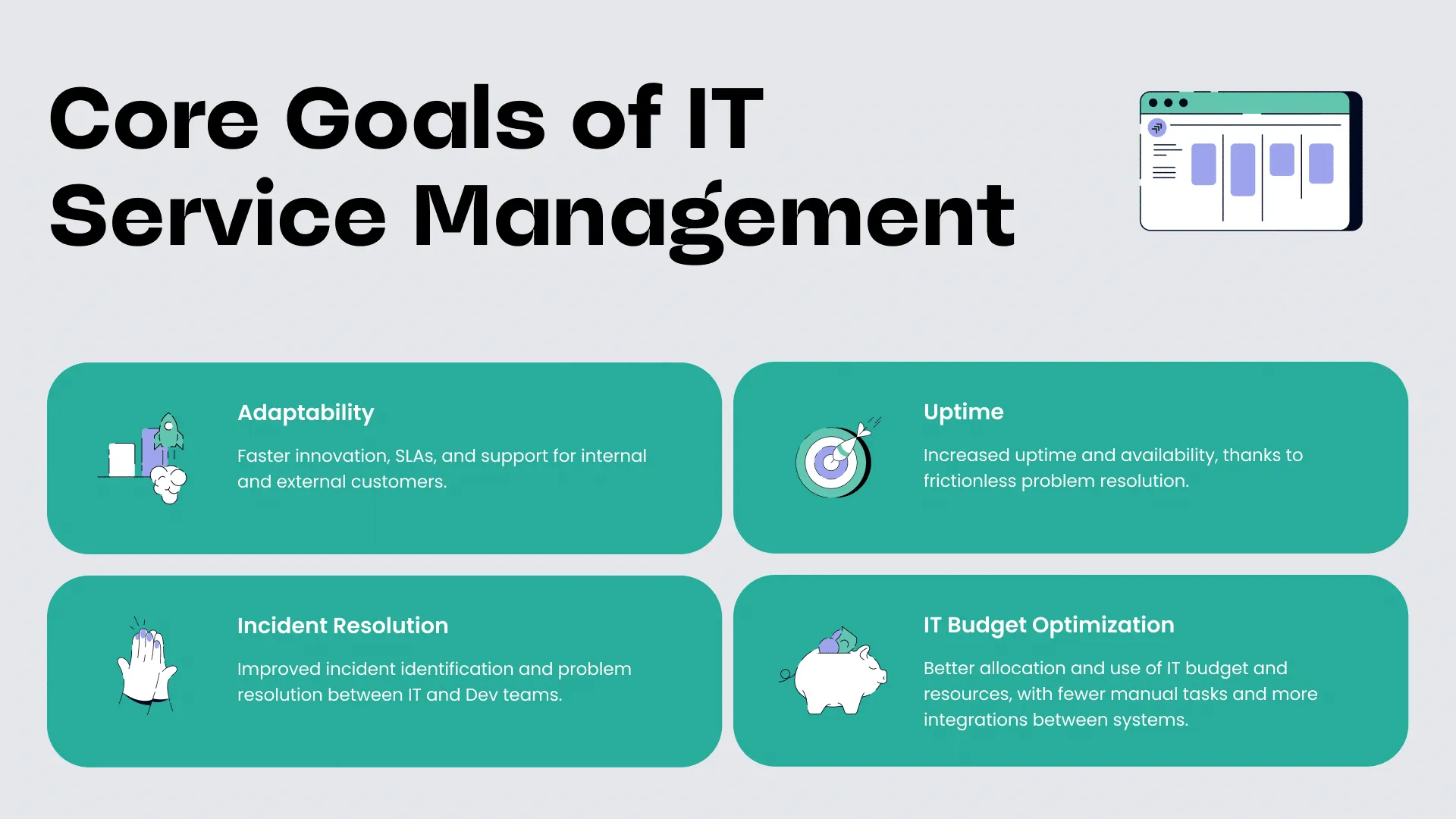
ITSM aims to improve IT performance and service delivery by focusing on standardized processes, efficiency, and customer satisfaction. ITSM supports:
- Faster innovation and adaptability
- Improved incident and problem resolution
- Increased uptime and availability
- Better use of IT budgets and resources
To achieve these goals, implementing ITSM requires an ITSM software (the “how”, so tools that help do the work) and an ITSM framework (the “what” and “why” (strategy and best practices).
What Is ITSM Software?
ITSM tools support key workflows—such as incident, change, asset, and request management—to help IT teams deliver value. The best ITSM software is easy to adopt, scalable, and promotes cross-department collaboration.
At Seibert, we help organizations unlock the full potential of ITSM with Jira Service Management—a modern, flexible solution built for seamless collaboration between business, development, and operations teams. Our offerings ensure every team has the visibility and tools they need to deliver exceptional service, fast.
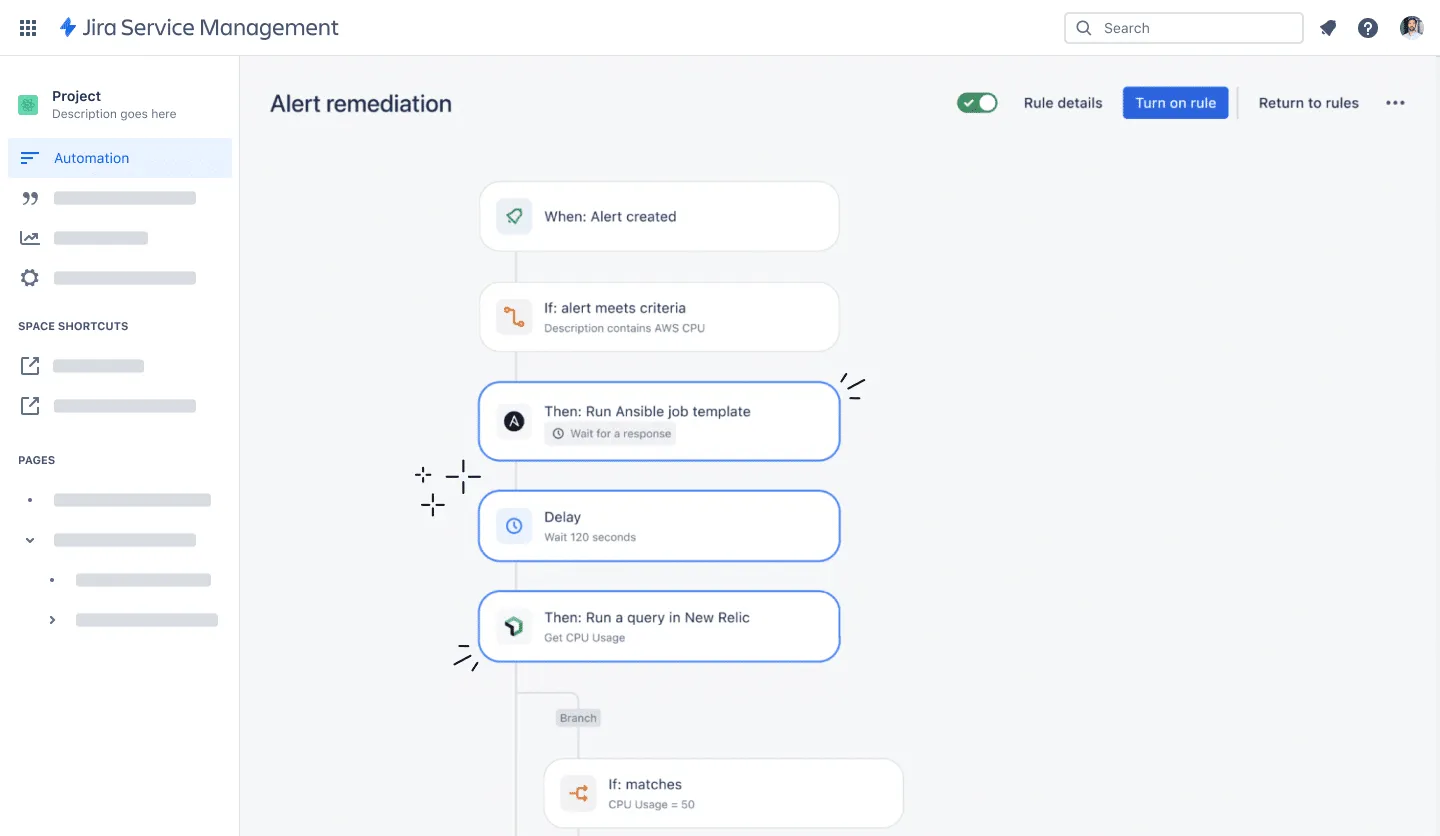
🔍 Real-Time Visualization of All Requests
With Jira Service Management, business and development teams can monitor incoming service requests in real time and respond efficiently, streamlining collaboration across departments.
👁️ Transparent Tracking
Service agents and customers have continuous visibility into the status of their requests. All updates and information are centralized and easy to access by integrating tools like Jira and Bitbucket.
🕒 Custom SLA Configuration
Define and store service level agreements (SLAs) tailored to customer contracts. Automatically prioritize incoming requests based on service time, tier, or issue severity.
📊 Detailed Performance Reports
Stay on top of service delivery with automated reports and real-time dashboards. Monitor key metrics such as response times, resolution times, and request volumes at a glance.
🔄 Connecting Dev and Ops
Ensure full traceability with comprehensive audit trails for every change. By integrating with Bitbucket Pipelines, your teams can reduce risk, maintain quality, and accelerate delivery.
🔌 Integrations and More
Customize Jira Service Management with over 1,000 Atlassian Marketplace apps and seamlessly integrate with the entire Atlassian ecosystem. Tailor the interface and workflows to suit your team’s exact needs.
Common ITSM Frameworks
We have the ITSM software or tool. But, what about the strategy or best practice? This is where the ITSM framework comes in! ITSM frameworks are guiding principles, best practices, and standardized processes for delivering and managing IT services. Organizations often adopt one or more frameworks to implement ITSM, including:
- ITIL® – Stands for Information Technology Infrastructure Library, and is one of the most widely used ITSM frameworks. Some services include IT-related assets, accessibility, and resources that provide value and benefits to customers.
- COBIT – Developed by the Information Systems Audit and Control Association (ISACA), COBIT is a governance framework and toolset that complements ITIL by providing oversight, control, and assurance to ITIL’s service management practices.
- ISO 20000 – ISO/IEC 20000 is a globally recognized standard for IT service management that ensures an organization’s ITSM processes align with business objectives and international best practices. It provides a framework for benchmarking service delivery, measuring performance, and maintaining consistent service quality.
- DevOps – DevOps is a collaborative approach that brings together cross-functional teams and promotes open communication to unify previously disconnected practices, adapting them to meet the business’s specific needs.
What Is ESM (Enterprise Service Management)?
What is ESM? Enterprise Service Management (ESM) takes the principles of ITSM and extends them beyond the IT department to other areas of the organization, such as HR, Finance, Legal, Facilities, and more.
ESM Builds on ITSM
Think of ESM as the natural evolution of ITSM. While ITSM focuses on managing IT services, ESM applies the same tools, methodologies, and best practices across the entire business, enabling standardized service delivery in all departments.
Example: HR can use ESM for onboarding requests, Facilities for maintenance tracking, and Legal for contract approvals—all using similar workflows to those used in IT.
ITSM vs ESM
Why Extend ITSM to ESM?
By applying ITSM principles across the business, ESM helps organizations:
- Break down departmental silos
- Improve service transparency
- Increase operational efficiency
- Enhance employee and customer satisfaction
- Reduce costs with shared tools and processes
ITSM and ESM Work Together
To recap the core differences in the ITSM vs ESM conversation:
- ITSM is about optimizing IT service delivery using standardized processes.
- ESM builds upon this by applying those practices across departments, making service management an organization-wide capability, not just an IT function.

Organizations looking to improve overall service delivery, reduce inefficiencies, and drive digital transformation should consider how ITSM can serve as the foundation for a broader ESM strategy. Ready to streamline service delivery across your entire business? Contact Seibert today to discover how our ITSM and ESM solutions can help you drive real organizational change.