
The modern workplace is more connected, digital, and fast-paced than ever, and employees expect internal services to keep up. Whether they’re onboarding, requesting equipment, or resolving an HR issue, today’s workforce wants seamless, consumer-grade experiences from the departments that support them.
This is where Enterprise Service Management (ESM) comes in. ESM brings the efficiency and structure of IT Service Management (ITSM) to every corner of the organization — from HR and Legal to Facilities and Finance. By unifying service delivery, enabling self-service, and automating routine tasks, ESM enhances the employee experience and streamlines the work behind the scenes.
In this article, we’ll break down exactly how ESM empowers employees, improves internal service delivery, and boosts productivity — and how your organization can take advantage of it.
What Is ESM and Why Does It Matter for Employee Experience?
Enterprise Service Management (ESM) extends the principles of IT Service Management (ITSM) beyond IT to support all departments, including HR, Facilities, Legal, and Finance. It creates a unified platform for internal service delivery, bringing structure, accountability, and automation to everyday processes.
At its core, ESM is about making it easy for employees to get the support they need, whether they’re requesting equipment, onboarding a new team member, or submitting an HR query. By streamlining access, enabling self-service, and ensuring consistent support, ESM revolutionizes the way employees interact with internal services.
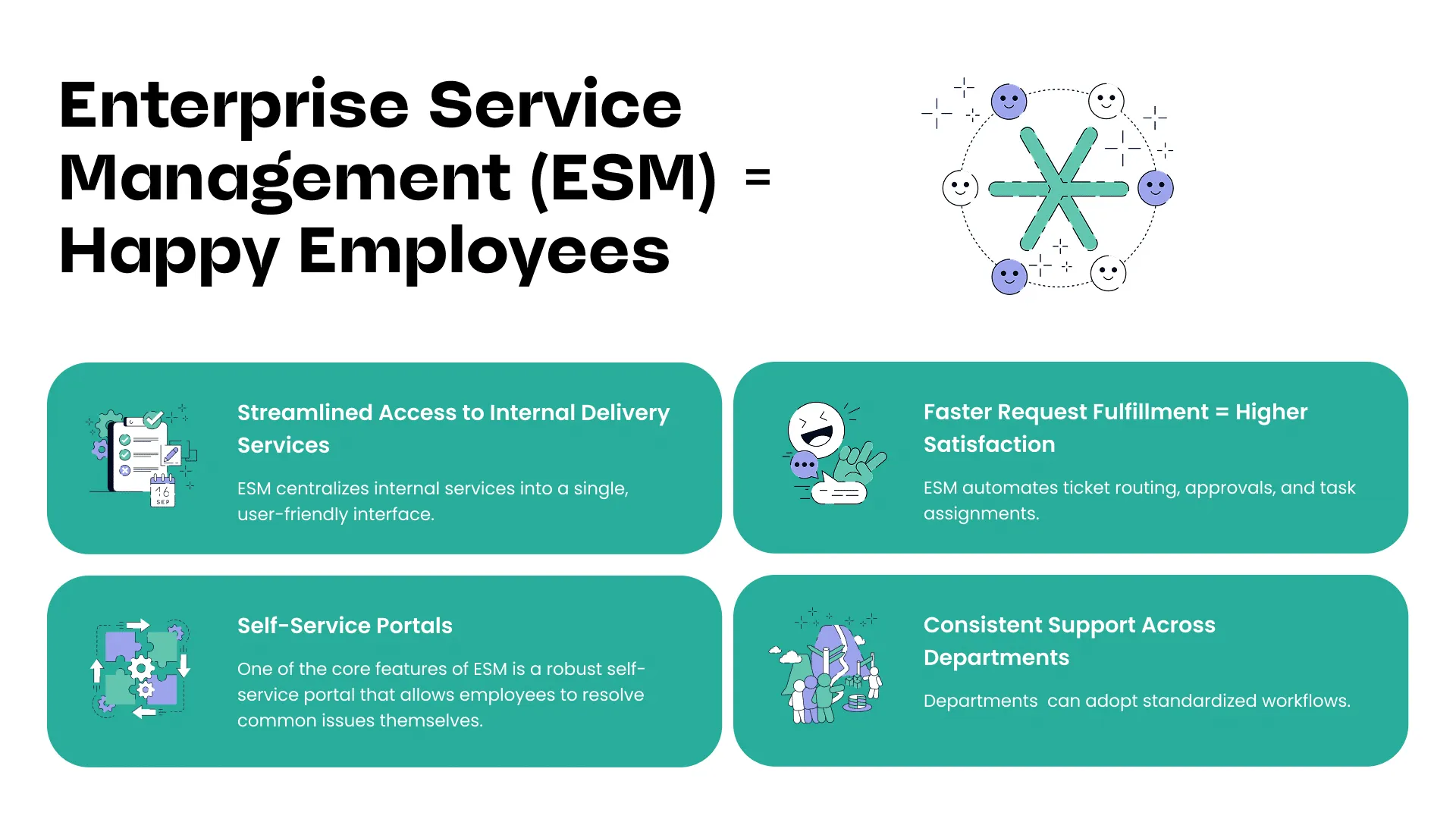
When implemented effectively, ESM enhances the employee experience through several key channels:
- Centralized access to internal services through a single, user-friendly interface
- Faster request fulfillment via automated routing, approvals, and task management
- Empowered employees through intuitive self-service portals
- Consistent support with standardized workflows across departments
Why is a seamless employee experience necessary? That’s easy. Employees make up the backbone of your organization. It directly impacts employee engagement, retention, and ultimately, business success.
Engaged employees are productive employees. According to a Gallup study, when employees feel motivated, the quality of their work improves, and in turn, it boosts business profits by a significant 23%. Not only this, but businesses that prioritize their employee experience see 59% less employee turnover, thereby retaining top talent in the long term (Source: Gallup)
I’m sure we’ve convinced you already of the importance of a satisfying employee experience. In the sections ahead, we’ll explore how ESM drives these outcomes — and how your organization can put it into action. Let’s dive in.
Streamlined Access to Internal Delivery Services
ESM centralizes internal services into a single, user-friendly interface. Instead of searching multiple platforms or contacting various departments, employees can submit and track requests from one centralized location.
For example, using Jira Service Management (JSM) as an HR application tracking system, recruiters and hiring managers can collaborate in real time, speeding up the candidate review process and reducing administrative overhead.
This unified access not only enhances transparency but also significantly reduces frustration, improving the overall employee experience (and potential future employees).
Self-Service Portals for Empowered Employees
A core feature of Enterprise Service Management (ESM) is the self-service portal — a centralized, user-friendly platform that enables employees to resolve common issues independently. Whether it’s resetting a password, accessing onboarding materials, or booking a meeting room, self-service empowers employees and eliminates unnecessary back-and-forth.
Why it matters:
- Employees get 24/7 access to answers without waiting for support
- HR, IT, and admin teams reduce repetitive tickets and gain time back
- Consistent information and workflows build trust and reinforce autonomy
This capability is especially impactful in HR, where timely and accurate support is critical to employee satisfaction. Once again, platforms like JSM — often at the heart of an ESM strategy, support self-service portals (Jira is just one tool in the Atlassian ecosystem; other tools in collaboration can be used for seamless HR management).
For example, HR teams using JSM can provide employees with a centralized service desk for standard requests, including leave balances, policy updates, payroll inquiries, and benefits information. JSM also enables:
- Automated workflows for tasks like leave approvals and compliance tracking
- Smart ticket routing to reduce delays and manual handoffs
- Transparent, trackable service delivery that employees can trust
By adopting JSM as an ESM solution, organizations deliver consistent, consumer-grade service across departments, driving both operational efficiency and employee satisfaction.
Faster Request Fulfillment = Higher Satisfaction
When internal requests are handled quickly, employees feel valued and supported. ESM automates ticket routing, approvals, and task assignments, ensuring the right person responds promptly.
For example, instead of HR manually routing a benefits inquiry, the ESM system categorizes and forwards it based on predefined workflows, reducing bottlenecks and response lag. Over time, this creates a culture of responsiveness and reliability, key pillars of employee experience management.
Consistent Support Across Departments
Every team — from Human Resources to Finance — can benefit from a structured approach to service delivery. With ESM, internal departments adopt standardized workflows, ensuring consistent quality of support across the board.
This consistency:
- Minimizes confusion and miscommunication
- Increases cross-departmental alignment
- Supports scalable growth as the organization expands
When employees know what to expect, they trust the system — and by extension, the company. That trust translates into greater engagement, retention, and productivity.
The ROI of Prioritizing Employee Experience Management
Investing in employee experience management through ESM isn’t just a feel-good initiative — it’s a strategic imperative. When internal services are easy to access, responsive, and consistent, employees are free to focus on high-value work rather than chasing down support.
From internal delivery service efficiency to automated HR workflows and self-service portals, ESM enhances the workplace in meaningful, measurable ways. Seibert Solutions can help you set up a service desk with Jira Service Management for better internal service delivery. Contact us today to get started on prioritizing organizational efficiency and employee experience.