

This guide provides a clear, step-by-step roadmap to help your business begin with ESM in manageable stages and grow successfully over time. We’ll cover what ESM and JSM are, how JSM supports an enterprise service management framework, why adopting ESM matters, and practical steps to get started with JSM.
What is Enterprise Service Management (ESM)?
Enterprise Service Management (ESM) is a strategic approach that brings service management methodologies, roles, and technologies into play across every business area. Service management originated from IT Service Management (ITSM), which was developed in the 1980s to bring structure and consistency to IT operations through widely adopted frameworks like ITIL, USM, and FITSM.
As organizations saw the benefits of these practices in IT, they began applying the same principles to other departments such as HR, finance, and facilities, leading to the evolution of Enterprise Service Management. Emerging in the early 2000s, ESM now enables organizations to break down silos, streamline service delivery across functions, and drive greater efficiency, transparency, and agility throughout the enterprise.
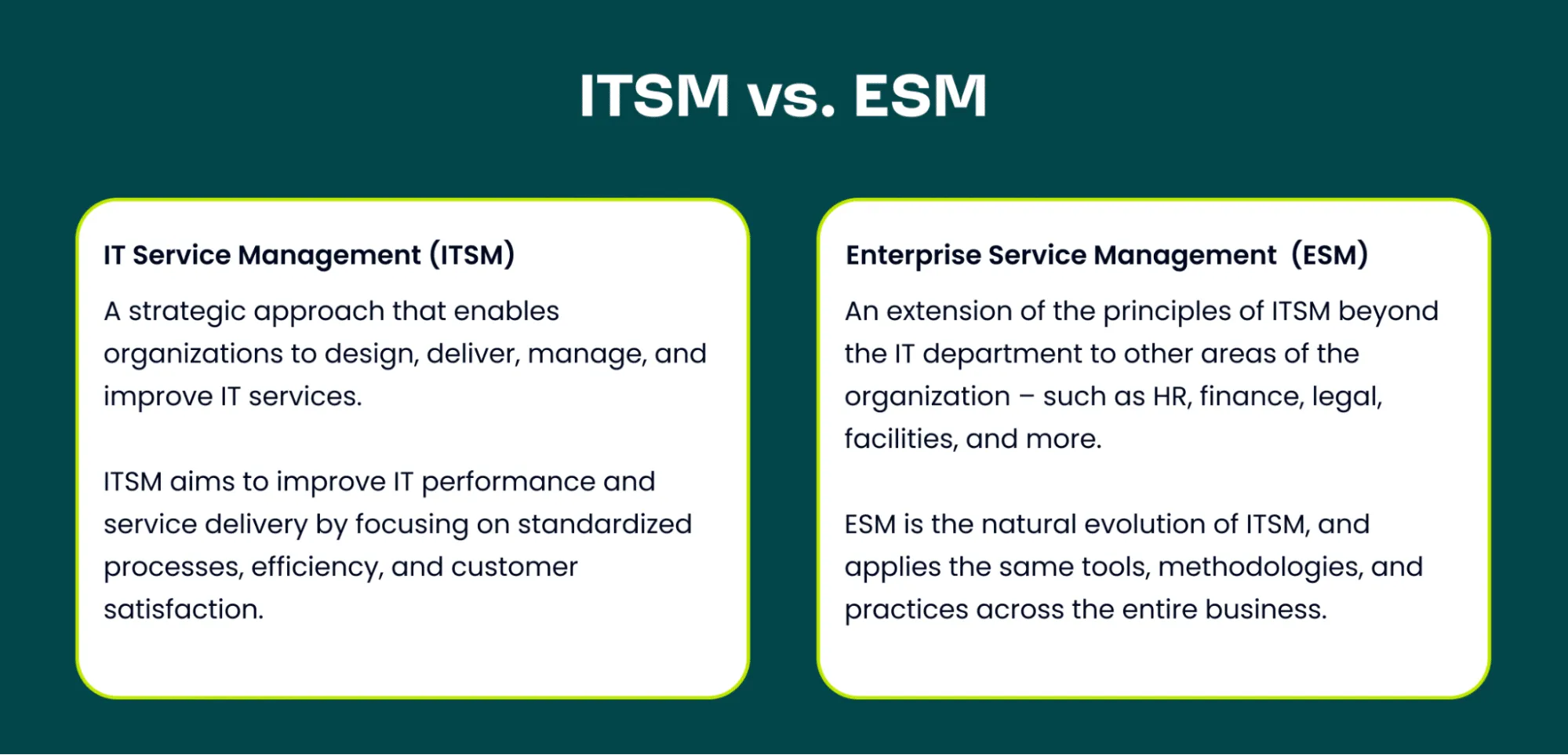
ITSM vs. ESM
While ITSM focuses on managing and optimizing IT services, ESM expands those principles to other departments. ESM builds on ITSM’s foundation to streamline service delivery across the organization. Need help understanding the difference between ITSM and ESM? This breakdown offers clarity.
What is Jira Service Management (JSM) and How Does It Support ESM?
Jira Service Management (JSM) is a flexible platform by Atlassian that helps organizations deliver efficient service across all departments. For example, HR can use JSM to manage employee onboarding requests, track approvals, and automate reminders – all within a single, transparent system. This unified approach makes adopting ESM easier by streamlining service delivery and improving operational efficiency across the organization.
Why Adopt an Enterprise Service Management Framework?
Adopting an Enterprise Service Management (ESM) framework brings measurable value to organizations by driving greater efficiency, streamlining internal workflows, and enhancing customer and employee experiences.
One major driver of this transformation is the growing use of AI in service management, which supports more intelligent automation, faster response times, and more personalized service across departments.
According to Atlassian’s 2024 service management report (source: Atlassian):
- 80% of professionals say AI has improved data-driven decision-making
- 79% report better customer service delivery
- 78% say workforce efficiency has increased
Organizations can unlock these advantages across departments by extending service management practices with AI-powered tools like Jira Service Management.
Roadmap: Adopt Enterprise Service Management (ESM) with Jira Service Management (JSM)
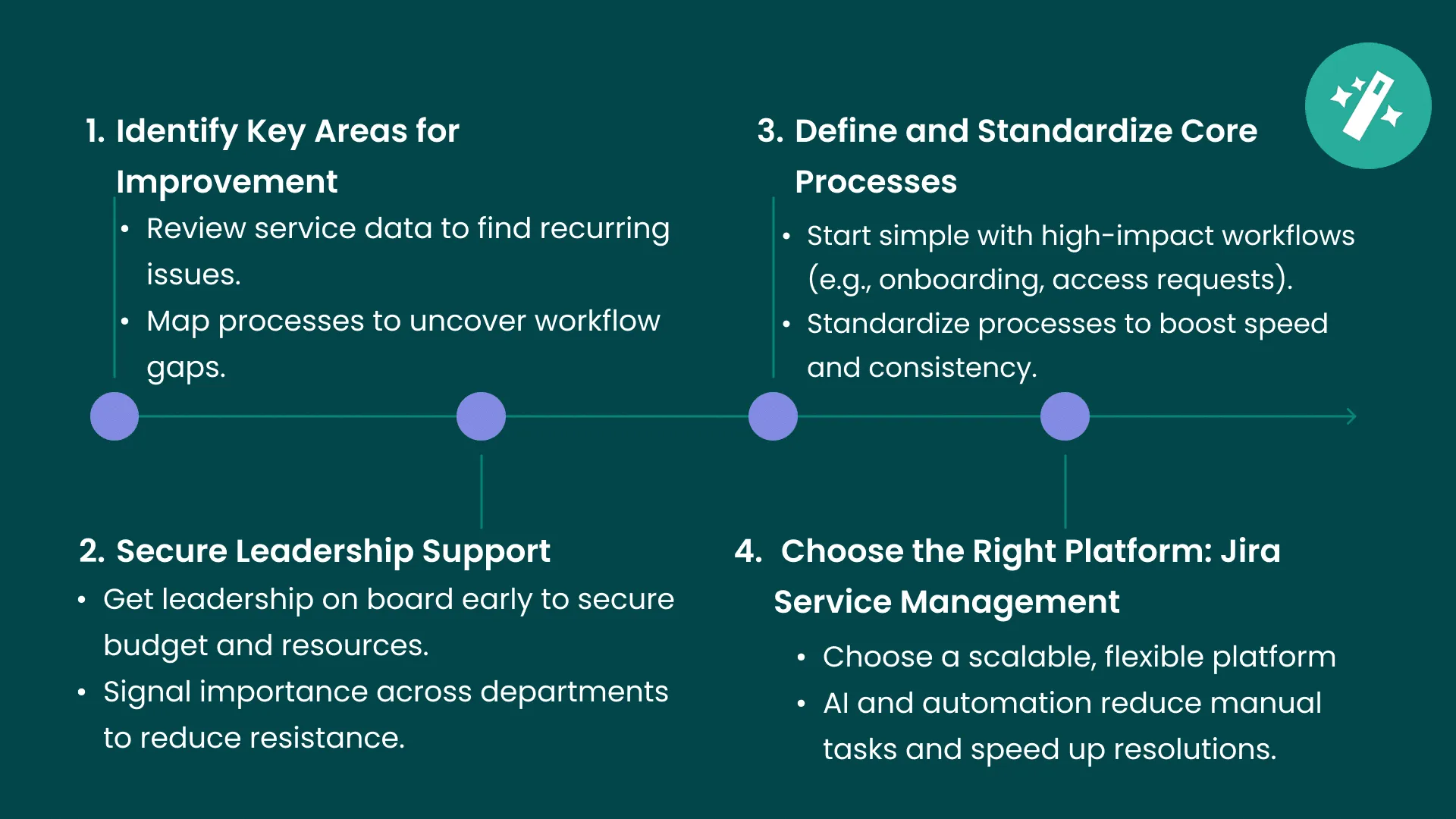
Step 1: Identify Key Areas for Improvement
Start by assessing service inefficiencies. For example, consider asking your departments these questions:
- Are HR requests handled via emails and spreadsheets?
- Do employees know where to go for common needs?
- Are finance and facilities tracking work manually?
Beyond these questions, use other strategies to uncover key improvement areas:
- Analyze service desk data to spot recurring issues and bottlenecks.
- Conduct process mapping to visualize and identify inefficiencies in workflows.
- Perform benchmarking against industry standards or similar organizations.
- Host stakeholder workshops to gather insights and build consensus.
- Evaluate your current technology with health checks for tool limitations or integration gaps.
- Review compliance and risk areas to identify vulnerable processes needing attention.
Step 2: Secure Executive Buy-In
Getting leadership on board early is essential for successful Enterprise Service Management (ESM) adoption. When executives and managers actively support the initiative, it ensures you have the resources, budget, and organizational alignment needed to move forward.
Leadership buy-in also helps signal the importance of ESM across departments, making it easier to overcome resistance and encourage collaboration. It ensures your initiative aligns with broader business goals like improving employee experience, increasing efficiency, or meeting compliance requirements.
Step 3: Define and Standardize Core Processes

At the beginning of your ESM journey, it’s important to keep workflows straightforward and manageable. Focus on high-impact, high-volume service areas that benefit most from streamlined processes.
Common starting points include employee onboarding and offboarding, equipment or access requests, and handling time-off or policy inquiries. These everyday tasks can quickly become time-consuming if handled manually or inconsistently.
By standardizing these core processes, you create a clear, repeatable way for teams to handle requests. This reduces errors and delays, and improves the experience for employees and service agents alike.
JSM supports this by allowing you to define service-level agreements (SLAs) to ensure requests are handled within agreed timelines. You can automate routine tasks like approvals, notifications, and ticket assignments, allowing your team to focus on more complex work. Additionally, JSM leverages AI capabilities to automatically categorize incoming tickets and escalate urgent issues, helping your teams respond faster and more accurately.
Step 4: Choose the Right Platform
Your ESM success hinges on selecting a platform that’s easy to configure and flexible enough to grow with your organization’s needs. Atlassian’s Jira Service Management (JSM) is purpose-built to support enterprise-wide service management, making it a superior choice to many alternatives.
Unlike traditional tools that can be rigid or require heavy IT involvement, JSM offers low-code configuration, allowing teams to build and adjust workflows without needing developers. This empowers departments across your business to tailor the platform quickly to their unique needs.
JSM also features intelligent automation and AI capabilities, such as auto-routing, ticket categorization, and summarization, which help reduce manual work and speed up issue resolution. Its seamless integration with Atlassian’s ecosystem—including Confluence for knowledge management and Jira Software for development tracking—provides a unified environment that boosts collaboration and transparency across teams.
These strengths make Jira Service Management a future-proof platform that simplifies the adoption of ESM and drives continuous improvement and scalability across your organization.
Ready to set up Jira Service Management?
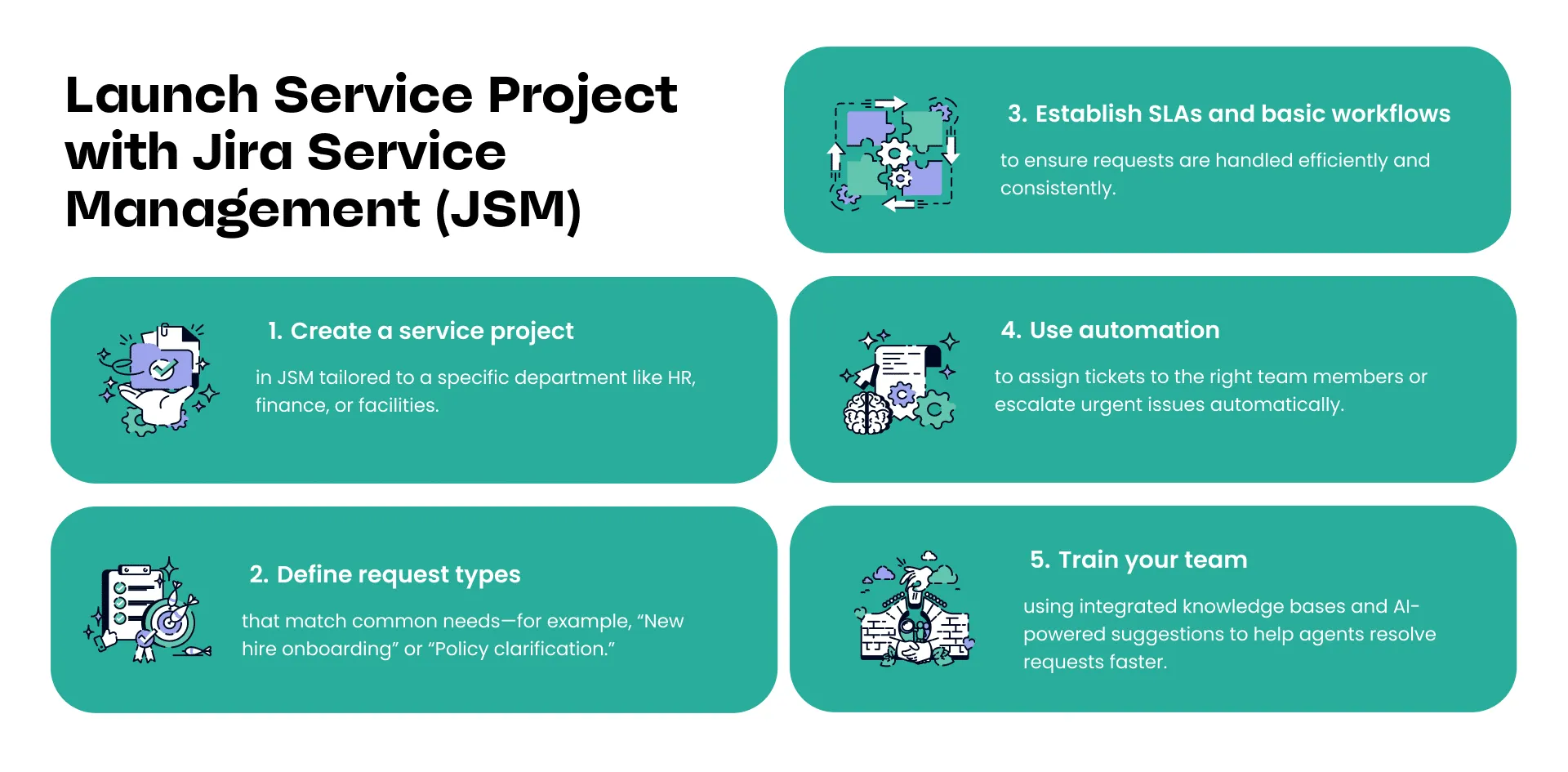
Follow these five simple steps to launch your first service project and start delivering seamless support across teams:
- Create a service project in JSM tailored to a specific department like HR, finance, or facilities.
- Define request types that match common needs—for example, “New hire onboarding” or “Policy clarification.”
- Establish SLAs and basic workflows to ensure requests are handled efficiently and consistently.
- Use automation to assign tickets to the right team members or escalate urgent issues automatically.
- Train your team using integrated knowledge bases and AI-powered suggestions to help agents resolve requests faster.
By following these steps, you’ll set a solid foundation for Enterprise Service Management that can scale and adapt as your organization grows.
Work with Seibert Solutions
Implementing an enterprise service management framework doesn’t have to be a solo journey. Seibert Solutions can help you assess your readiness and ESM opportunities, set up scalable, easy-to-use Jira Service Management portals, and train teams to ensure long-term success. Contact Seibert Solutions today to get started with building high-impact service desks across your organization.