
Adopting enterprise service management (ESM) can be a transformative step for organizations aiming to streamline service delivery across departments.
If your internal services feel like a game of chaos bingo, (service quality varies wildly by department or manual processes are killing your team’s productivity) it’s most likely in your interest to adopt ESM.
By extending IT service management principles to functions like HR, Finance, Facilities, and beyond, companies can unlock significant efficiency gains, better user experiences, and stronger organizational alignment.
However, the journey to ESM maturity can be challenging. Many organizations face significant hurdles when adopting enterprise service management, from change resistance to technological missteps. Understanding these challenges—and preparing the right responses—can make the difference between success and stagnation. In this article, we’ll take a look at 6 common challenges when it comes to adopting enterprise service management, and ways you can solve these problems.
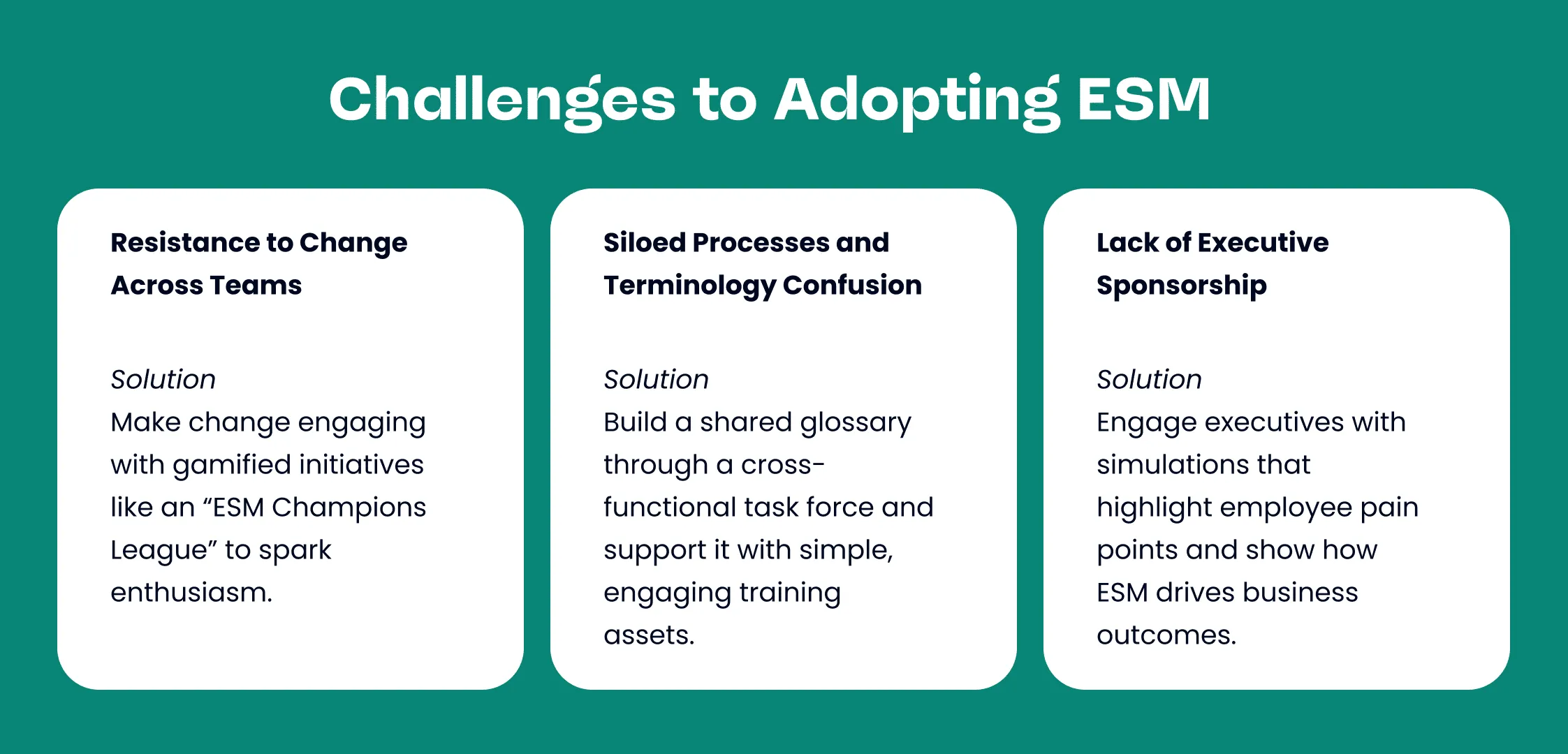
Resistance to Change Across Teams
The Challenge:
A frequent barrier to successful ESM adoption is internal reluctance to shift away from established ways of working. Many teams are used to their own tools, processes, and autonomy. When asked to conform to a centralized ESM approach, they often push back—especially if they perceive ESM as IT-centric.
How to Tackle It:
Turn hesitation into enthusiasm by making adoption fun and rewarding. For example, launch an internal “ESM Champions League” where departments compete on ESM milestones. Reward early adopters and celebrate innovative use cases. Turning change into a game fosters buy-in and brings a sense of ownership to the transformation process.
Lack of Executive Sponsorship
The Challenge:
Without strong executive backing, ESM projects can struggle for funding, visibility, and organizational buy-in. If leaders view ESM as “just another IT tool” rather than a strategic initiative, implementation will stall.
How to Tackle It:
Create an “Executive Experience” simulation. Walk decision-makers through a day-in-the-life of employees navigating siloed, inefficient service delivery processes. Show how adopting enterprise service management solves real pain points—and tie ESM benefits to business outcomes like speed, satisfaction, and cost savings.
Siloed Processes and Terminology Confusion
The Challenge:
Departments often operate with inconsistent terminology. What’s an “incident” in IT may be a “case” in HR or a “work order” in Facilities. This fragmented language confuses users and complicates cross-functional collaboration.
How to Tackle It:
Form an “ESM Linguistics Task Force” with representatives from each department. This team should develop a shared glossary and align terminology for service requests, workflows, and statuses. You can support the rollout with visuals, micro-videos, or interactive FAQs that make this common language easy to digest and apply.
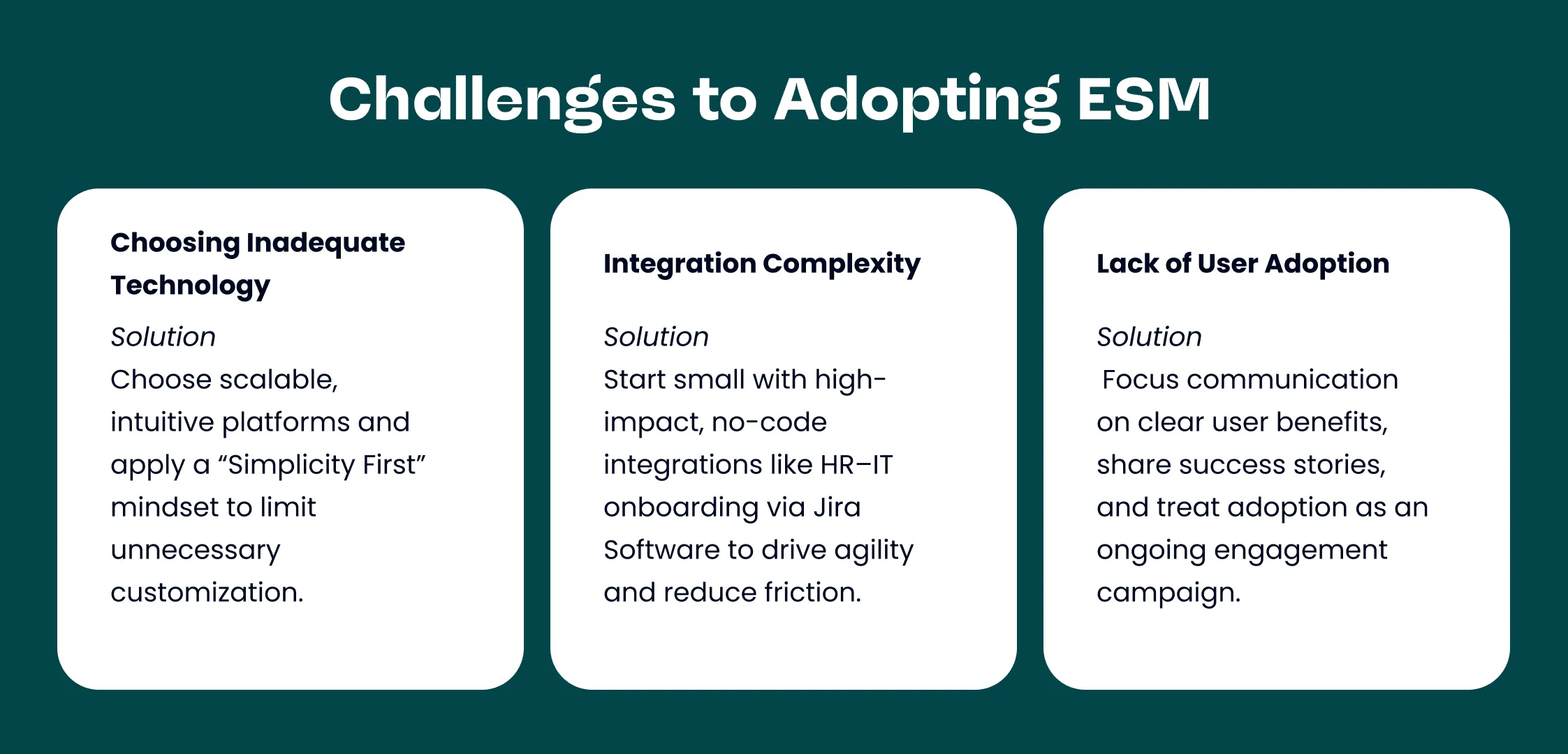
Choosing the Wrong Technology (or Over-Customizing It)
The Challenge:
Organizations often get stuck selecting the right platform when adopting enterprise service management. Some rush into using existing ITSM tools for every department, while others over-customize to fit legacy processes—leading to complexity and poor adoption.
How to Tackle It:
Prioritize intuitive, scalable platforms that can meet departmental needs without excessive customization. Implement a “Simplicity First” rule: ask teams how they can adapt to standard workflows before requesting custom features. Encourage adoption of industry best practices rather than replicating outdated processes.
Integration Complexity
The Challenge:
Unifying various legacy systems and departmental tools into a single ESM platform can result in costly integration challenges—especially when dealing with incompatible APIs, siloed data, or rigid infrastructure.
How to Tackle It:
Adopt a “Micro-ESM” strategy by starting small with high-impact integrations—such as connecting IT and HR for smoother employee onboarding. Use these early successes to build internal credibility, secure additional budget, and refine your approach to broader implementations.
To reduce technical friction, leverage no-code workflow builders that empower departments to design their own service processes without heavy IT involvement. For example, HR can build a new employee onboarding workflow that integrates directly with Jira Software, ensuring alignment with IT provisioning, while Facilities can automate preventive maintenance tasks based on location and resource availability.
By using no-code platforms, organizations can rapidly deploy ESM solutions tailored to the specific needs of each department—boosting agility, encouraging adoption, and breaking down silos without the complexity of traditional development.

Lack of User Adoption
The Challenge:
Even if you roll out the perfect system, employees won’t use it if they don’t see value. If users don’t understand how adopting enterprise service management benefits their day-to-day work, they’ll revert to old habits.
How to Tackle It:
Embed user benefits into your communication strategy. Explain how ESM will reduce task duplication, speed up approvals, and clarify responsibilities. Offer training, highlight user success stories, and provide channels for feedback. Remember: user adoption is a campaign, not a checkbox.
Planning for Success When Adopting Enterprise Service Management
Adopting enterprise service management isn’t just a technology decision—it’s an organizational shift that requires strategic planning, cross-functional collaboration, and persistent advocacy.
To avoid common pitfalls:
- Secure executive buy-in early
- Simplify before you customize
- Start small, prove value, then scale
- Prioritize understanding over fast implementation
When executed with care, adopting enterprise service management can unify your organization, streamline service delivery, and elevate employee and customer experiences alike.
Tackle ESM Challenges with Seibert Solutions
At Seibert Solutions, we don’t just implement tools — we build sustainable enterprise service management ecosystems. From IT and HR to Facilities and Finance, we help teams work smarter with scalable solutions like Jira Software that simplify workflows, accelerate response times, and eliminate silos.
Let’s design a system that grows with your organization. Reach out to Seibert Solutions today and take the next step toward a more connected, efficient, and employee-centric service experience.