

If you’ve ever messaged HR for a benefits question via Slack, submitted a facilities request through an Excel form, or emailed Finance five times to approve a purchase — only to be met with silence — you’re not alone. Most organizations have figured out how to manage IT requests, but everything else? It’s a bit of a mess.
That’s where Enterprise Service Management (ESM) comes in.
ESM takes the service management, structure, efficiency, and practices of IT Service Management (ITSM) and expands it to every internal service team — from HR to Finance to Legal. Think of it as giving every department a modern, streamlined way to deliver services to employees — with transparency, accountability, and less chaos.
But how do you know if ESM is something your organization actually needs? Here are five red flags — and how ESM can help fix them.
1. Service quality varies wildly by department
One team uses a ticketing system. Another uses email. A third has you fill out a Google Form that disappears into a black hole. Sound familiar?
When every department manages requests differently, employees never know what to expect. Worse, they waste time figuring out where to go or chasing down status updates.
How ESM helps: ESM standardizes service delivery across all departments. HR, Facilities, Legal, and others can all use the same workflows, approval logic, and request tracking. That means consistent quality — and way fewer “Did you get my email?” follow-ups.
2. Manual processes are killing your team’s productivity
If approvals still rely on PDFs, paper forms, or someone shouting across the office (or Zoom), your workflows aren’t just outdated — they’re actively holding you back.
How ESM helps: ESM introduces workflow automation. Need an onboarding checklist that involves HR, IT, and Facilities? ESM routes everything automatically, tracks progress, and sends reminders. No more manual nudges or missed steps. Your processes finally work for you — not the other way around.
3. Employees don’t know where to go for help
In a perfect world, employees would go to a single place to request anything: tech support, time off info, a desk move, a travel approval. In reality? It’s a scavenger hunt.
How ESM helps: ESM provides a centralized service portal — one place for all employee needs. It’s searchable, trackable, and full of helpful self-service resources. Your teams spend less time asking around and more time getting things done.
4. You have no visibility into internal service performance
How many HR requests are pending? Which departments are slammed with work? Where are approvals getting stuck? If your answer is “we don’t really know,” you’re flying blind.
How ESM helps: With real-time dashboards and performance analytics, ESM gives managers insights into workloads, request statuses, and service bottlenecks. You can track SLAs, improve response times, and optimize resource allocation — with data to back it up.
5. Departments are stuck in silos
When departments don’t talk to each other, service delivery breaks. HR might onboard someone, but forget to notify IT. Facilities don’t get the memo about a new hire needing a desk. Employees get a frustrating experience, and teams get blamed for things outside their control.
How ESM helps: ESM builds cross-departmental workflows. Everyone involved in a process — HR, IT, Facilities, Legal — gets looped in automatically. Teams collaborate in sync, not in silos.
Before vs. After Enterprise Service Management
Here’s a quick look at what life looks like before and after implementing ESM:
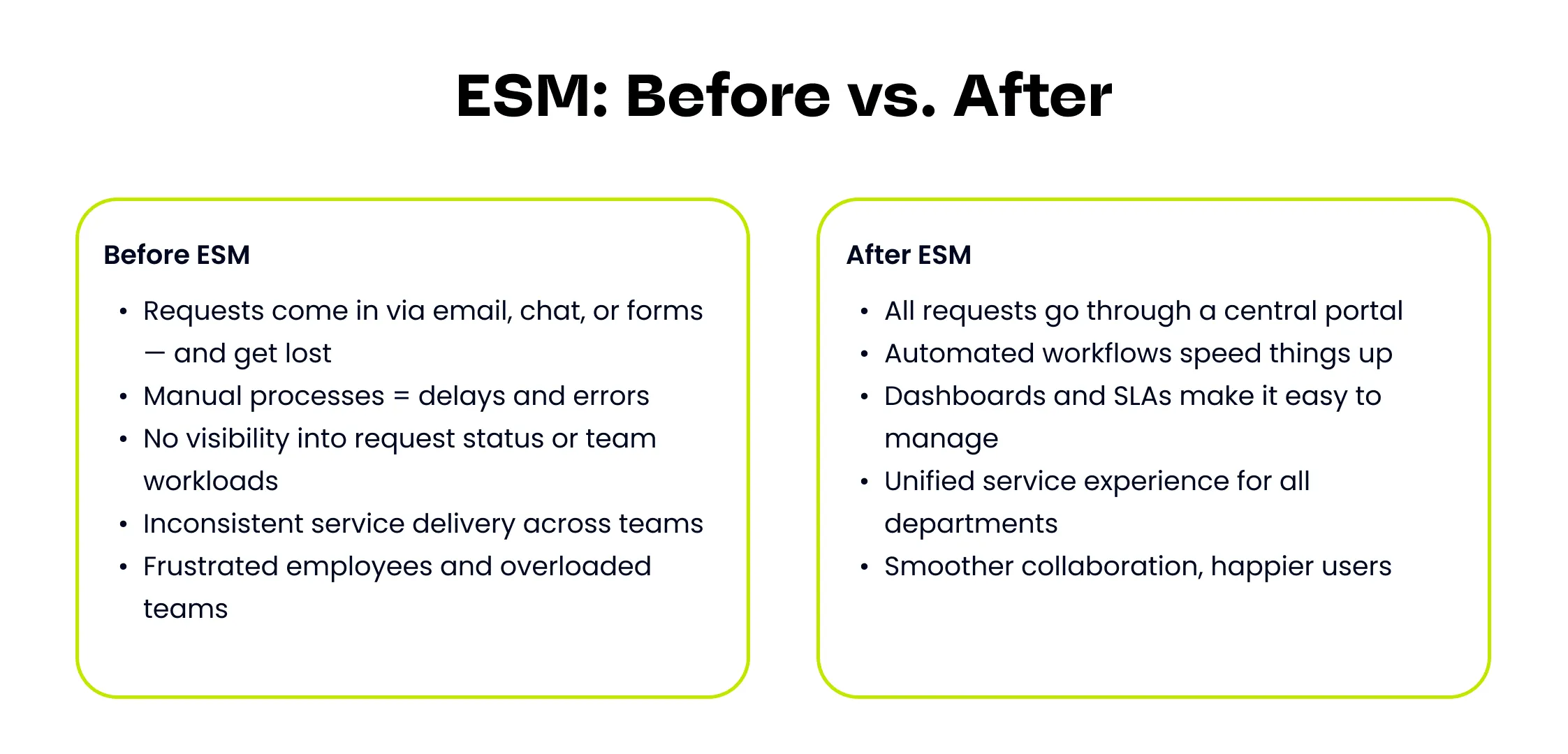
Seeing the contrast makes it clear: ESM isn’t just about new tools—it’s about enabling a more efficient, connected, and employee-friendly way of working.
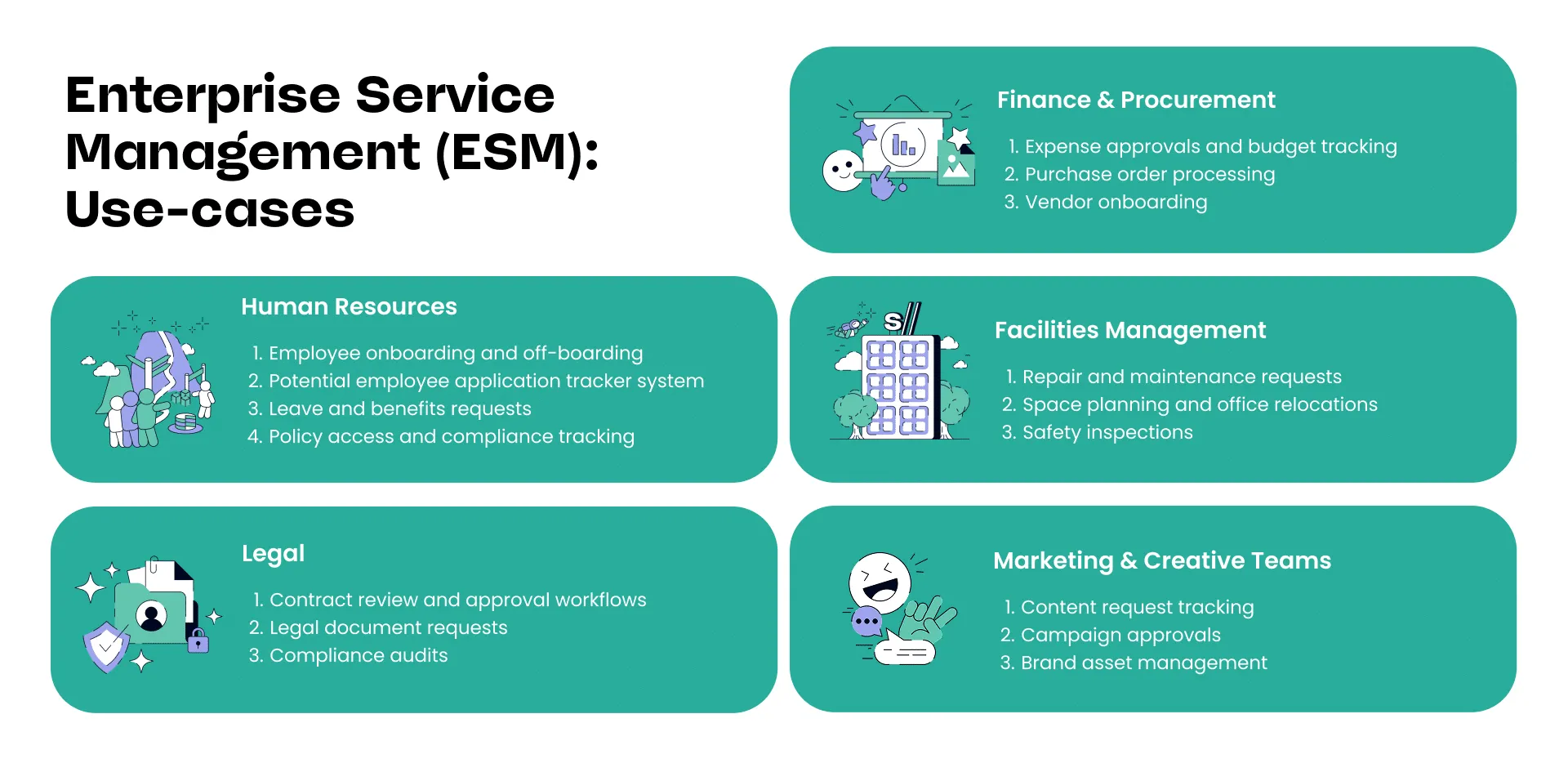
Where ESM Makes a Difference
Still not sure where to start? These are some of the most common use cases where Enterprise Service Management shines:
Human Resources – Employee onboarding and offboarding, employee application tracker system, leave and benefits requests, policy access and compliance tracking, etc.
Legal – Contract review and approval workflows, legal documentation requests, compliance audits, etc.
Finance & Procurement – Purchase approvals, expense processing, budget queries
Facilities Management – Repair and maintenance requests, space planning, office relocation, desk moves
Marketing & Creative Teams – Content request tracking, campaign approvals, brand asset management, design help, etc.
ESM supports all of this without needing five different tools.
How is ESM Transformative?
Today’s organizations run on services — internal and external. If internal teams can’t deliver those services efficiently, employees get frustrated, productivity takes a hit, and things fall through the cracks. ESM isn’t just about technology. It’s about transforming how your people work together.

Enterprise Service Management (ESM) integrates IT Service Management (ITSM) frameworks with advanced technologies, automated workflows, and a centralized ITSM platform to optimize processes, enhance communication, accelerate service delivery, and boost both customer and user satisfaction.
It gives you:
- Visibility into what’s working (and what’s not)
- Scalability as your team and complexity grow
- Consistency across every department
- Efficiency as workflows are automated
- Happier users and customers who can actually find help when they need it.
Ready to Get Started?
If your internal services feel like a game of chaos bingo, it’s probably time for Enterprise Service Management. Start small — onboard one or two departments — and grow from there.
Seibert Solutions empowers organizations to harness the full capabilities of Enterprise Service Management (ESM). Whether it’s enhancing HR onboarding processes, simplifying legal workflows, or consolidating internal service requests, our experts work with you to build a customized ESM solution that fits your unique operational needs.
Reach out to us at Seibert to explore how we can streamline your internal services, boost employee experience, and reduce organizational inefficiencies through smart ESM strategies.