

In this article, we’ll explore the challenges that complex distributed architectures introduce to the end-to-end release management process. We’ll discuss the foundational practices that help overcome these challenges, the platforms available to support them, and the organizational gains, such as improved observability, stronger feedback loops, and better alignment, that can bring confidence to scale without losing control.
The Challenge of Scale
As systems grow in size and complexity, more teams naturally become part of the end-to-end engineering process. Modern distributed architectures, often built on microservices and increasingly integrated with hardware, AI, and IoT, make this possible by enabling parallel development tracks and empowering team autonomy.
Most teams value autonomy. They want the freedom to experiment, to customize workflows, and even to use different Agile or DevOps frameworks within their own Jira projects. This flexibility accelerates local innovation, but it also fragments the global picture.
With every additional team and service, the number of integration points grows. Dependencies multiply, visibility shrinks, and the risk of release chaos rises exponentially. In complex chains, every link must succeed for a release to ship on time. One broken link can delay the entire delivery.
The symptoms are familiar: unclear or missed dependencies, often discovered at the last moment. Or worse, only after deployment. Long release cycles, unstable deployments, reactive firefighting, and a rollback culture become the norm.
To contain this growing complexity, organizations typically respond by introducing more manual reviews, approvals, and checkpoints, ironically slowing down the very velocity they set out to scale.
This is the paradox of scaling release management: autonomy fuels innovation, but without coordinated control, it breeds disorder.
Foundations of Scalable Release Management in Jira
Let’s look into some core principles, solutions and tools to succeed with Release Management in Jira at a scale.
Designing for Delivery
To avoid surprises at the end of the process, it’s essential to plan and orchestrate releases from the earliest stages. This requires a shift in mindset: from asking “What needs to be done?” to “How are we going to deliver it?”
By thinking about delivery upfront, teams can better define what will be done and how it will be executed. This approach elevates the release itself to a first-class citizen — something to be designed, managed, and optimized, not just executed at the end.
Balancing Control and Autonomy
The key question is how to strike the right balance between control and developer autonomy.
The answer isn’t to interfere less, it’s to interfere smarter: build on top of what teams already do well and integrate governance into their natural workflows.
One effective approach is artifact-based deployment. Each team owns the artifact that represents its component’s version and remains responsible for its quality and delivery. All artifacts then pass through a standardized release-management process, which serves as a common denominator across the organization. Through this process, dependency management is enforced, ensuring that artifacts are packaged into solutions according to their dependencies and required delivery order.
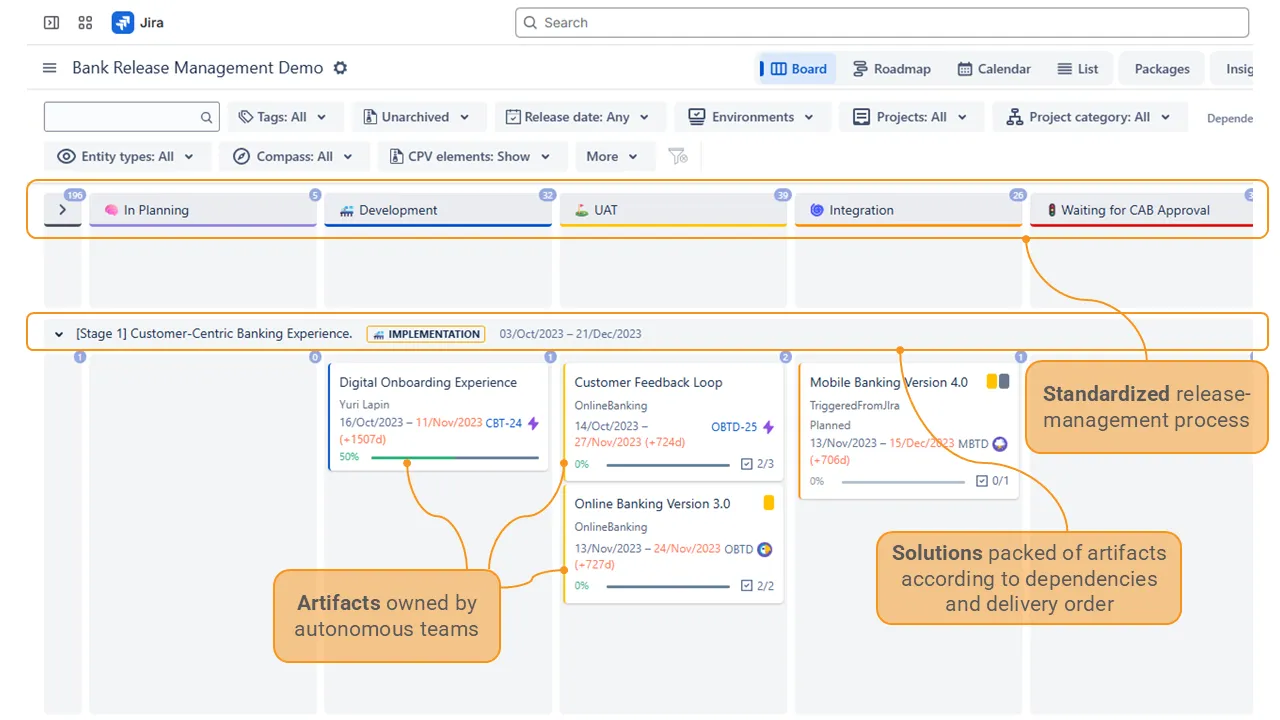
This model, showcasing release management in Jira, maintains team autonomy while ensuring consistent, traceable, and reliable solution delivery at scale.
Establishing Clear Artifact Ownership
Clear artifact ownership is essential when scaling release management. Each team should have sole responsibility for its products (e.g., applications, services, microservices, or hardware), define its own versioning semantics, and proactively manage both upstream and downstream dependencies.
This approach ensures accountability, clarity, and controlled evolution across the ecosystem — forming the foundation for reliable, autonomous releases. Atlassian Compass can play a pivotal role in formalizing this ownership — mapping teams, components, repositories, builds, environments, dependencies, and health metrics in one place.
Did you know? Atlassian now offers the Software Collection, a bundle of apps including Compass and Bitbucket, designed to help developers succeed. Learn more about Software Collection.
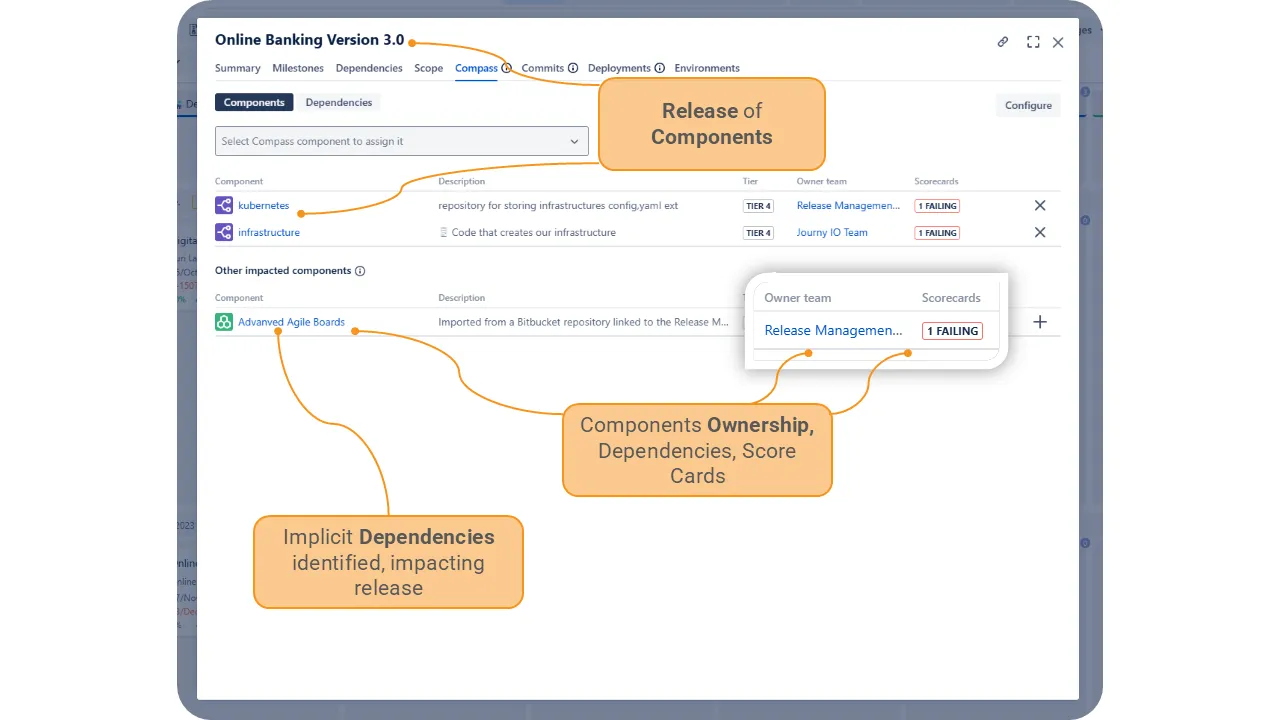
When integrated with the Release Management App for Jira, Compass becomes part of a unified release management framework — enabling consistent cross-project versioning, taxonomy, scheduling, and tracking in complex, interdependent environments.
Traceability and Transparency
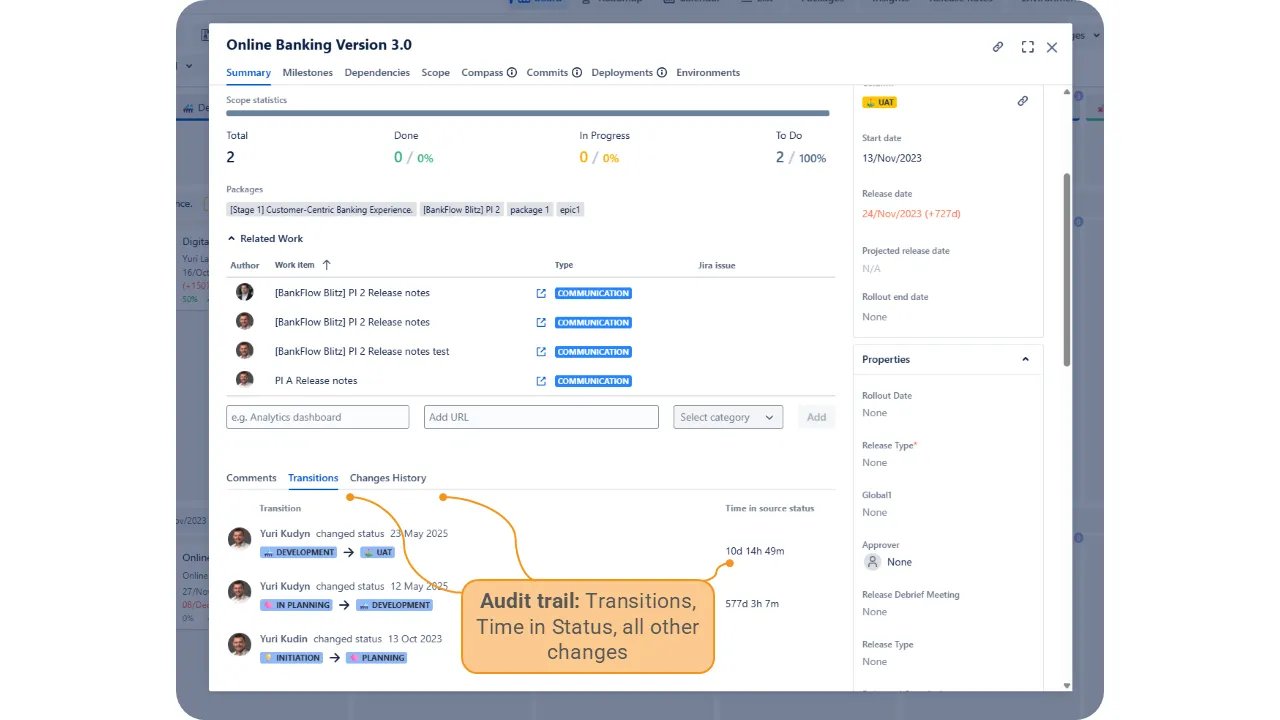
Every change should be traceable to a solution, release of component, work item, pull request, commit, and approval.
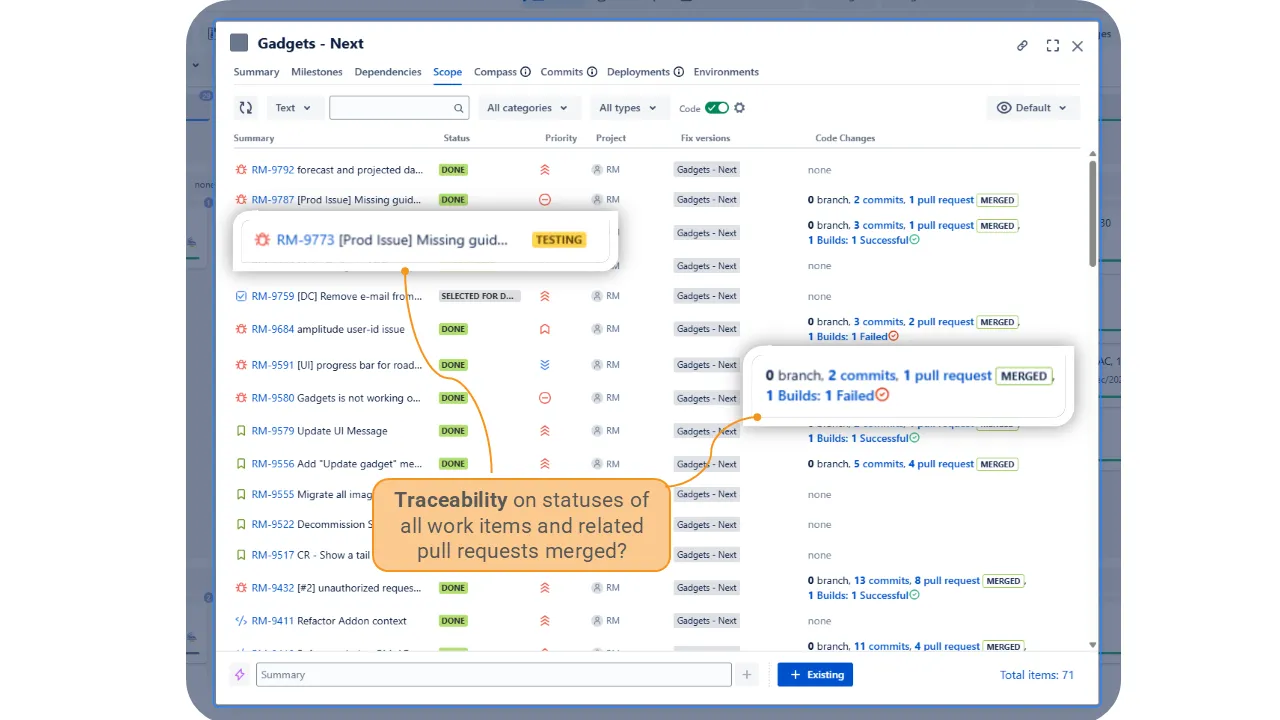
This principle establishes full transparency. It enables automated approvals, compliance, governance, and audit checks, as well as the observability and feedback loops essential for continuous improvement end to end.
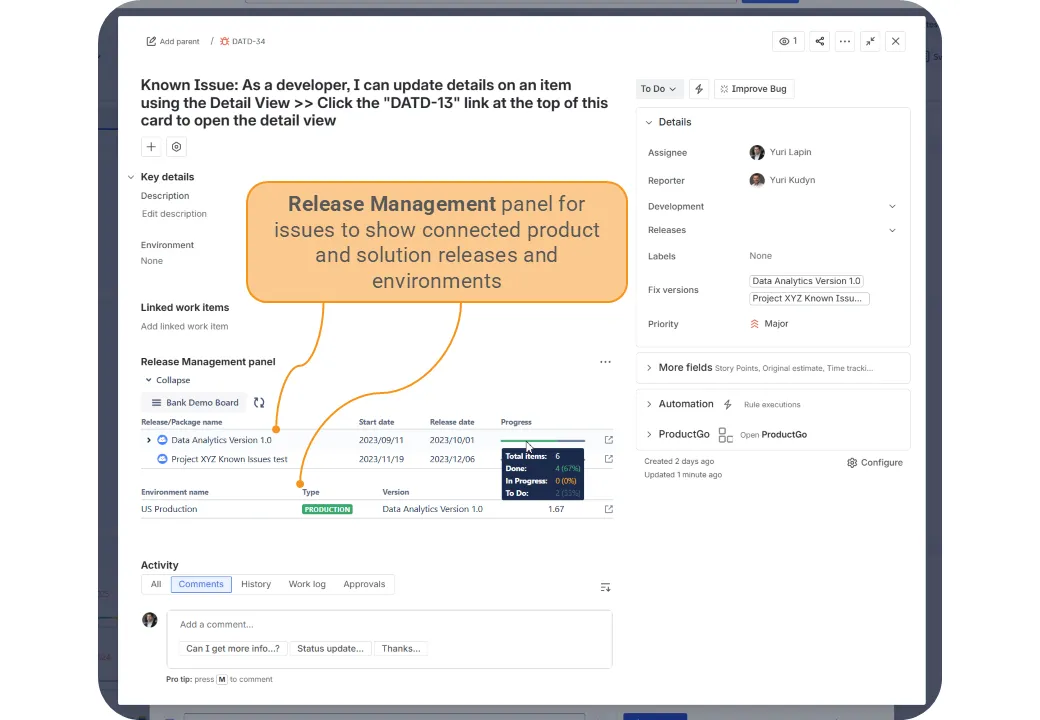
The good news is that auditability of components all the way down to individual commits comes out of the box with both Atlassian Compass and Release Management for Jira. Both tools provide auditability for releases all the way up to individual commits to solution. A combination of both gives a solid foundation for transparent, automated, and compliant end to end release processes.
Automation as the Backbone
A standardized release management process in Jira is not a constraint — it’s the foundation for automation and confidence at scale. Once the process is consistent, the number of automation opportunities grows exponentially. For example, automation can:
-
Trigger CI/CD pipelines to deploy artifacts, lock environments for integration testing, update release tickets with build numbers, and notify corresponding teams.
-
Trigger CAB approval flow, run automated quality gateways, summarize changes, and even schedule review meetings — automatically looping board decisions and feedback back to teams.
-
Align statuses of work items and releases across projects, close all related work items once a release is completed, propagate deployment dates, and create extra work items to follow-up and feedback.
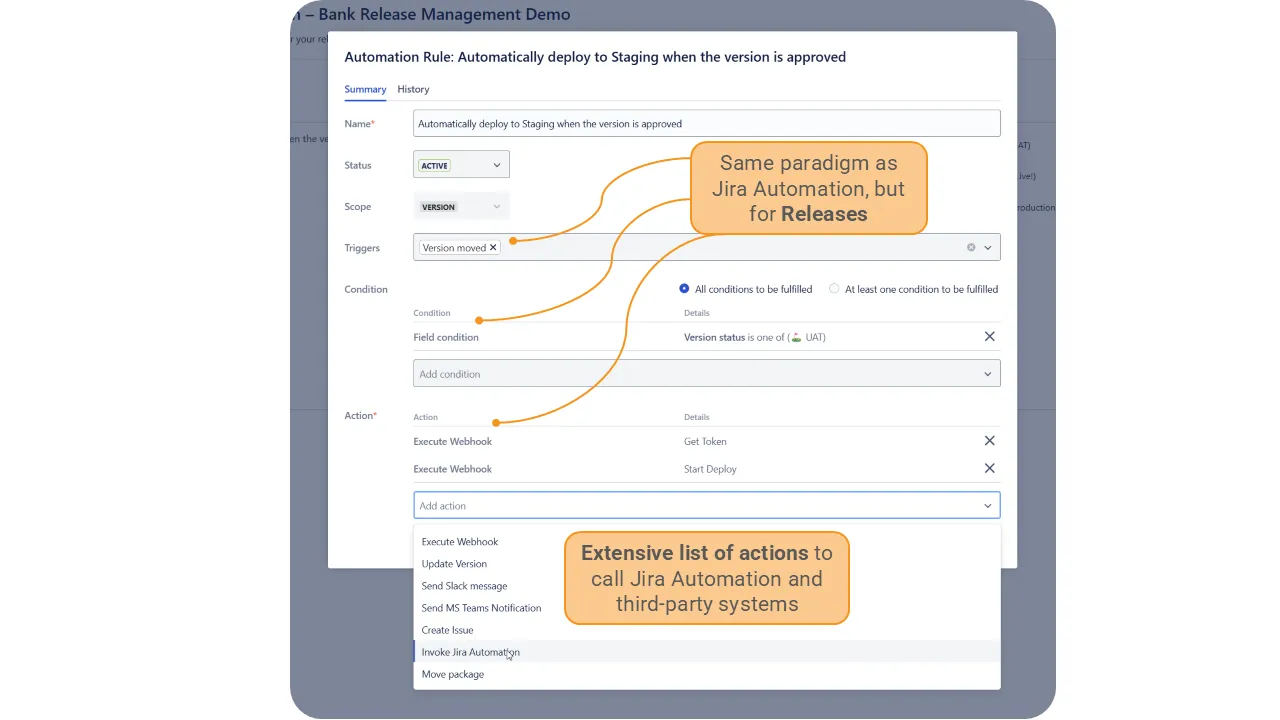
Jira Automation, Jira REST API, and the Release Management App’s Automation and REST APIs make it possible to design advanced automation flows securely, with governance and access token controls built in.
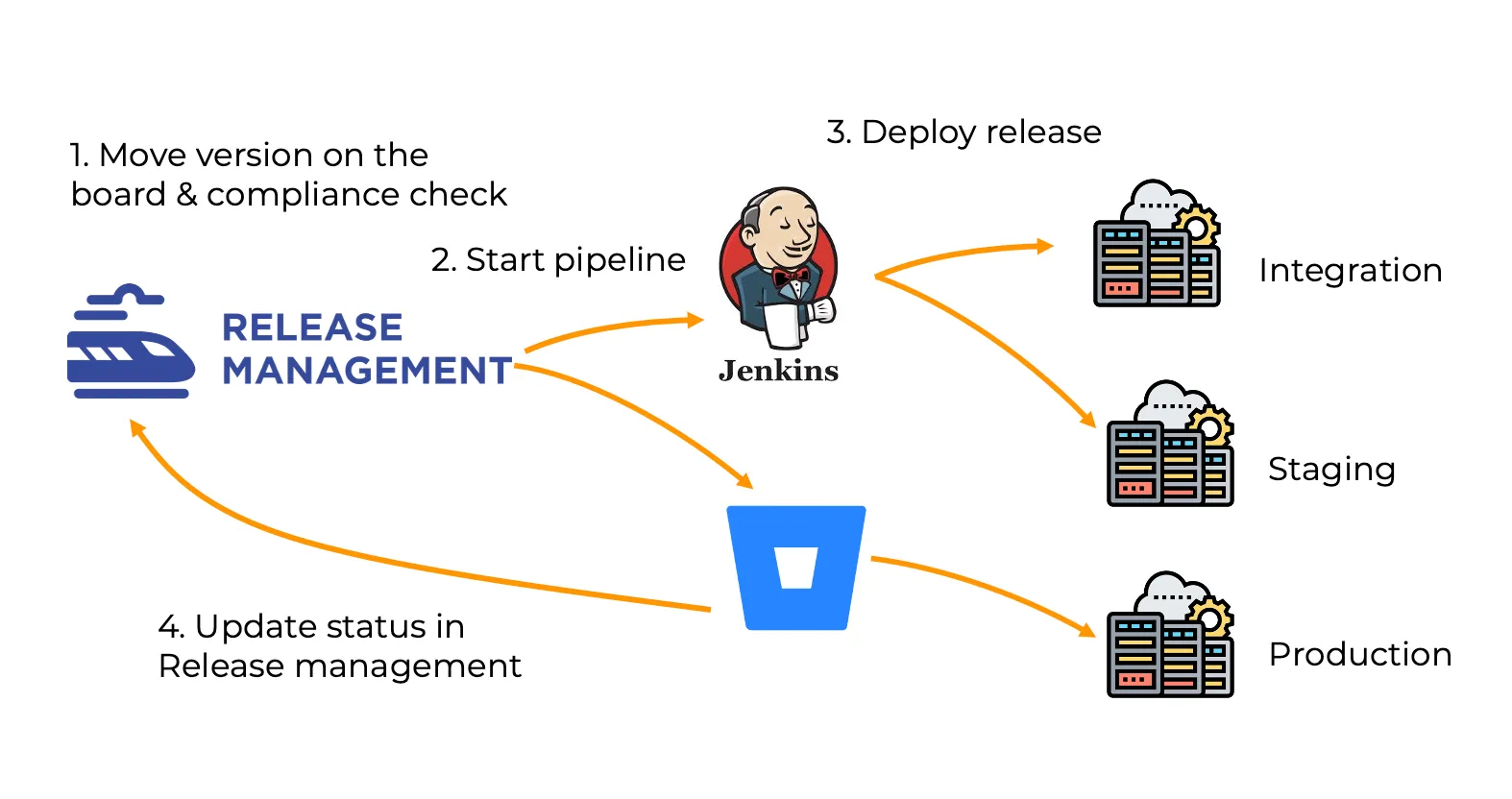
Standardization unlocks automation — and automation, in turn, reinforces consistency, compliance, and confidence.
Mastering Release Management in Jira at Scale
Scaling Release Management in large organizations operating complex systems inevitably brings the fear of losing control. It’s a natural reaction to increased complexity and interconnected dependencies.
The foundations we’ve already established—designing for continuous delivery, clear ownership of components and releases, a standardized release flow, and automation as the essential backbone—are the critical building blocks required to replace that fear with confidence.
However, these are merely the pillars. They support the structure, but they are not the finished building. To achieve true, ultimate gains, we must discuss what is built on top of these foundations.
In the following article, we will detail how to leverage these pillars to construct an Efficient Release Management Process at Scale, moving beyond basic stability to unlock superior speed, predictability, and business value.