
From early July to 1 November 2026 I had a fleet of AI coding agents. Up to 15 workers and one captain that handed out the work. I called it my terracotta army. On 1 November I switched it off. This is what happened in those four months, and why I now work with fewer agents.
This article is also available in German: 15 KI-Coding-Agenten parallel, dann habe ich aufgehört.
A coding agent is an AI that writes and changes code itself. I give it a task in plain language, and it edits the files, runs the tests and opens a pull request. It works on my computer or on one of our servers, and I can watch what it does.
What Firstmate Is
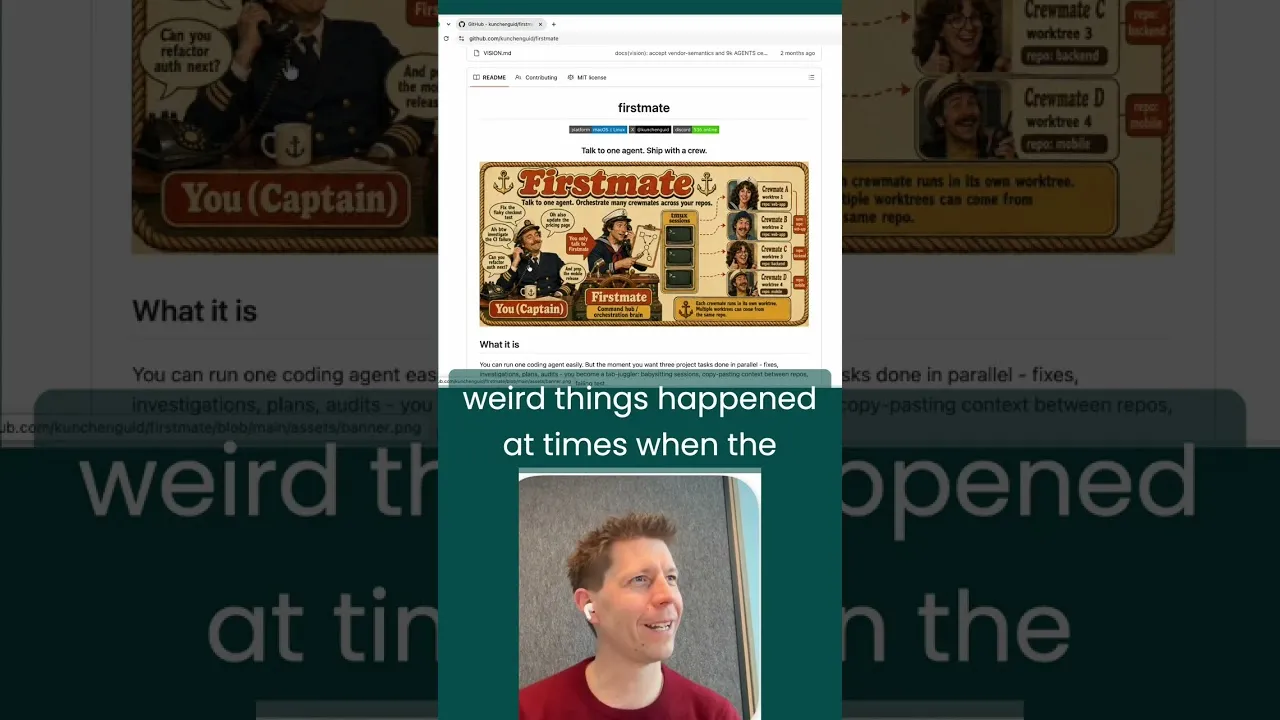
Firstmate is an open source project under the MIT license. Its promise: talk to one agent, ship with a crew. You talk to one agent, and that agent hands the work to the others. I call that one the captain and the others the workers. Firstmate itself calls them the first mate and the crewmates. The captain passes my tasks to the workers, they do the work and report back to the captain, and the captain reports to me.
I love that idea. I don’t have to talk to every agent myself, and the work goes on while I sleep, eat or sit in a meeting.
My Setup
Our IT gave me a big Proxmox server at Hetzner. On it I could run up to 15 agents in parallel. The agents ran on DeepSeek on SeibertGPT, our own AI server in Helsinki. I did not pay per token, so I could let the fleet build a lot of software.
One word I need a lot below: merge. Merging means a change is built into the program for good. The agents only merged into software I had built myself: my own tools and internal apps from my vibe coding projects. No customer systems, no finance systems. Every change went through its own branch, a pull request (PR) and the automated tests.
The Rush: 101 Merged PRs in Twelve Days
I gave the fleet tasks, and they came back delivered. Between 5 and 16 September, 101 pull requests from the fleet were merged. One example: our voice message product heard went from nothing to 11 merged PRs in five days.
Suddenly I found features in my programs that I did not want. It felt like the software was building itself. That was great.
How many hours it saved me, I can’t tell you. I never counted. What it cost, I never measured either. The hardware was already there.
The Bottleneck Was Me
Then the follow-up questions came. Fifteen workers asking me things all day made me dizzy.
By 16 September the fleet had put 50 decisions in front of me. 28 of them were still open. The work piled up on my desk.
When something really needed clarifying, I drew a blank. A worker came back and reported something, and I had lost the context completely. What is this about? What did I want here? Why? The agents had to explain themselves again and again.
My Approval Was a Formality
For database migrations I wanted to approve every merge myself. In reality, I only looked at whether our online PR agent, a second AI that reviews pull requests, had written “LGTM” (looks good to me). Then I merged.
I did not read a single diff. A database migration can drop a column or rewrite a table, and if it goes wrong the data is gone. I had that risk on my screen every time and never looked at it. The AI could have done that without me, and so I automated that step away as well.
Features I Never Wanted
My tasks were often ambiguous. When I did not answer the follow-up questions, the agents had to guess what I meant. Sometimes they guessed close to what I wanted, but not quite. I found features in my software that were similar to what I wanted and still wrong.
That was embarrassing. That was one reason I stopped.
What Else Went Wrong
A few mishaps from the four months, with dates:
- 6 September: A worker hung on a trust dialog for 36 minutes. In the process list it looked like a healthy worker.
- 7 September: I restarted a program the workers depended on. That killed 11 workers at once.
- 15 October: 14 workers were running. 13 of them were dead. The captain reported that everything was fine.
- 25 October: The disk was at 81 percent, almost all of it build caches, about 100 GB. On 26 October it was almost full.
- 29 October: The captain was gone for 38.7 hours.
I caused some of the trouble myself. When a task got stuck because I had not answered, I submitted the same task again. In the end the fleet had two tasks on the same topic.
Why I Stopped
There may be a time when a dark factory works. There may be people who can run Firstmate today and steer 15 workers at once. I am not that kind of person, and I don’t think I will get there for my work.
So I switched the fleet off on 1 November.
How I Work Now
I am back to T3 Code by Theo. I work with fewer agents at the same time, usually a handful of threads at a time. I can scroll up and down and see everything I am working on: what is running right now and what needs my attention. I get the context back quickly.
The agents mostly sleep when I sleep. Before I go to bed I give a few of them a goal, and they keep working on it until they reach it. At night only the few agents with a goal run.
Loading content...
One Step You Can Copy
Before you hand a task to an agent, decide which follow-up questions you really want to answer yourself. Allow the agent to decide everything else. If you then catch yourself clicking “looks fine” without reading, take that question off your list too.
Try It Yourself
Firstmate is on GitHub. SeibertGPT is a chat assistant that runs DeepSeek on our own server in Helsinki, inside the EU. Try SeibertGPT here. The fleet in this article is not part of SeibertGPT; that was my own setup on my own server.
If you want the bigger picture, I wrote about State of AI at Seibert Group.
I also wrote down how I use agents for my content marketing: One Recording, Eleven Videos: How I Automate My Content Marketing with AI Agents.