

The AI question that has been coming up more and more in conversations I’ve been having is: “Which model should we use?” Quickly followed up by, “Which one is the smartest?”
I have started giving an answer that might sound counter-intuitive: for most of the work most people do, intelligence is the wrong thing to buy.
Now, let me be clear: intelligence is still important. However, I’m advocating for looking more closely at model cost, speed, and intelligence as a whole, and not assuming the foremost, smartest frontier model is automatically the best fit for your use case.
The Intelligence Premium You Are Paying For
Frontier models keep getting smarter, and the benchmarks keep confirming it. What is less clear is whether anyone notices in practice.
For standard knowledge worker tasks (like drafting a message, summarizing a document, pulling an answer out of a contract, or thinking a decision through out loud), the difference between the best model available and a good open-weight model is hard to detect. My working estimate is that this covers 80 to 90 percent of the jobs where we use AI as a thinking partner or an administrative assistant rather than a frontier problem solver.
That leaves 10 to 20 percent where intelligence genuinely matters:
- Long, multi-step reasoning where an early mistake compounds
- Unfamiliar code, where the model has to hold conventions it has not seen
- Analysis where several constraints have to be held at once without dropping one
If your work lives in one of these three areas, then pay for the most intelligent model. It earns its price there. Most teams are not in that band, and they pay for it anyway, because the intelligence leaderboard is the only number anyone puts in front of them.
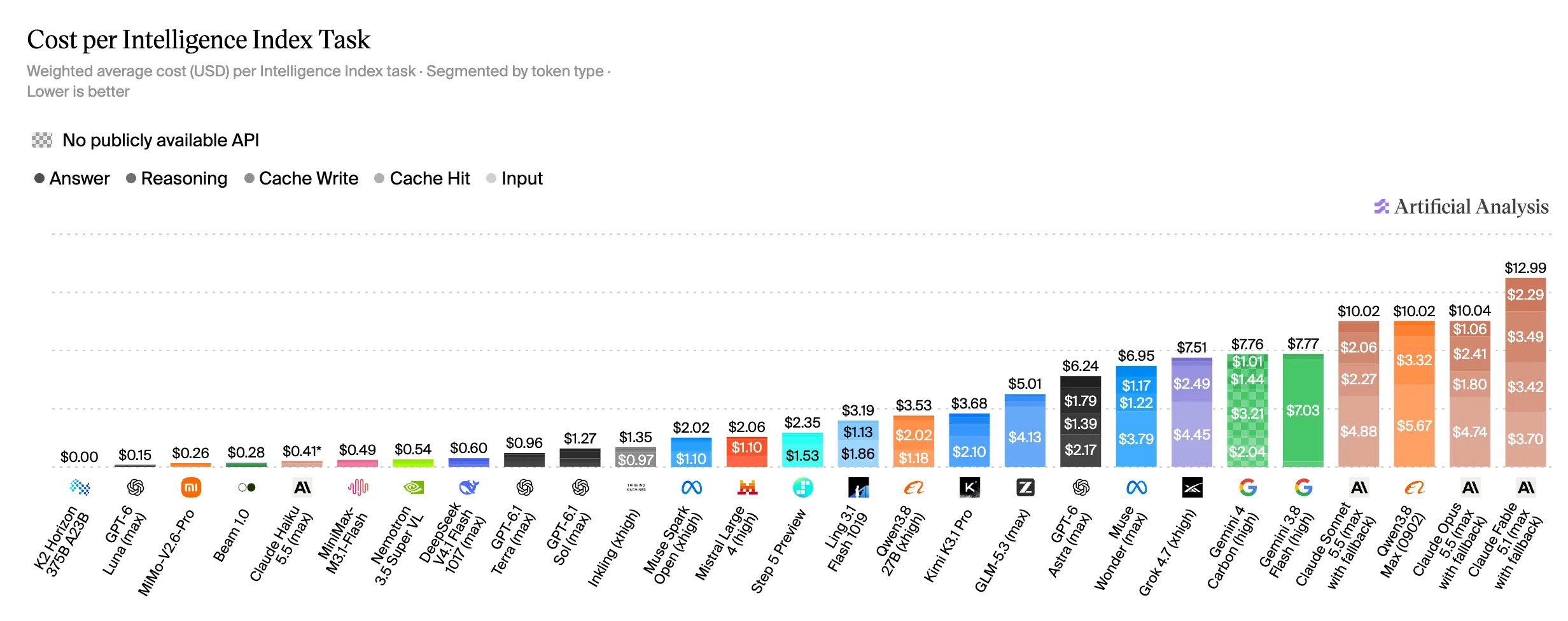
The evidence supporting my argument comes from Artificial Analysis, which tracks intelligence, output speed, and cost per task side by side across hundreds of models. As you can see above, the most intelligent models are also the most expensive per task.
Choosing Speed Over Intelligence
We see this play out at Seibert every day. Internally, we use both Claude and a self-hosted DeepSeek model. Claude is the stronger model on paper, but DeepSeek answers much faster, so my recommendation to the team is simple: use DeepSeek for most tasks, and switch to Claude only when the work genuinely needs the extra reasoning. For the bulk of our day-to-day work, nobody misses the difference in intelligence, but everyone notices the difference in speed.
The difference is easy to find once you look for it. The same model can respond noticeably faster in a terminal than in a browser, because the surrounding application adds its own delay on top of the model’s. Self-hosted open-weight models often feel faster still: no queue shared with thousands of other customers, no round trip to another continent, and no rate limit arriving at the worst possible moment.
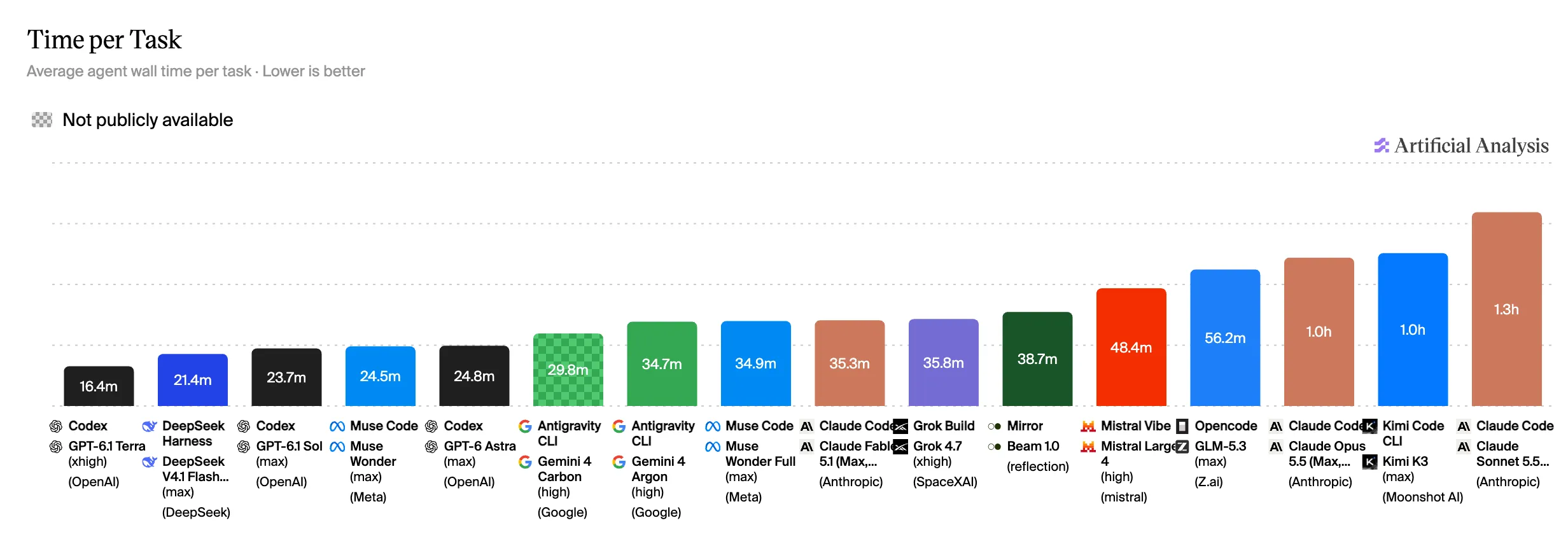
A tool that takes minutes to answer interrupts the thought you were trying to capture. And when a cheaper, slightly less intelligent model can respond much faster with information that is good enough to get the job done, that moves work forward.
The Cost Curve Does Not Behave Like Software
When comparing AI models, another important dimension to consider is cost. Software is usually priced per seat. The bill is predictable, and adoption is free, which is why every SaaS vendor wants more people using the product.
AI is usually priced per token. The bill grows with adoption, and adoption is the thing you are trying to encourage. A successful rollout can cost more than a failed one. That is an unfamiliar shape for anyone used to flat renewals.
Per token is also the wrong number to compare, and this is the part many evaluations miss. Reasoning models spend more tokens getting to an answer. A model that thinks for three times as long at half the price per token is not a cheaper model. Artificial Analysis measures cost per task for exactly this reason, and the rankings diverge, sometimes by a wide margin. Compare the price of finishing the job, not the price of a unit of thinking.
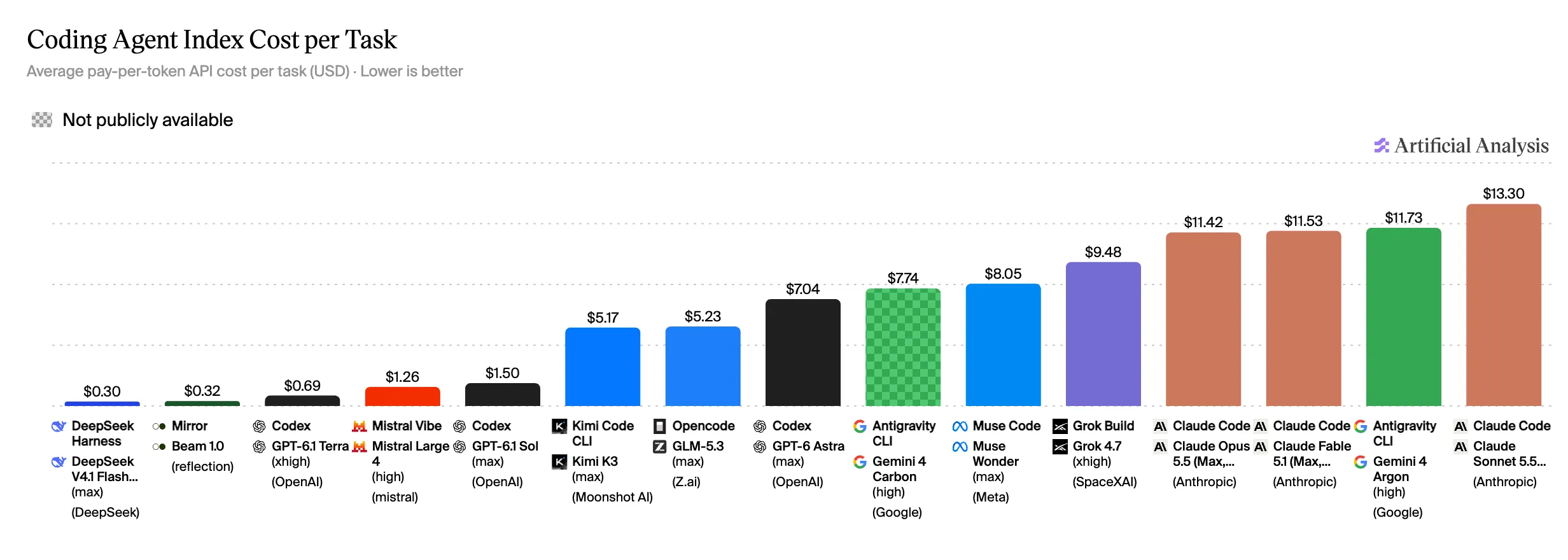
In addition to being significantly faster than Claude Code, DeepSeek is also the cheapest model when comparing cost per task. This is another factor that went into our decision to make both DeepSeek and Claude available to everyone at Seibert Group.
AI Model Selection: Route the Work Instead of Picking a Winner
The practical answer is not choosing one model. It is routing. So stop buying only the frontier model just because it’s the smartest. Intelligence still matters, but it matters less for most of the day-to-day tasks knowledge workers are asking AI for help with. Here’s my recommendation:
- Send the genuinely hard work, the 10 to 20 percent, to the frontier model, where the extra capability earns its price.
- Send the routine majority to something fast and cheap that is good enough, because for that work, good enough is what keeps things moving forward.
- When deciding which models to invest in, consider speed, cost, and intelligence together.
Where to Start, If You Don’t Know Where You Actually Stand
Many organizations cannot answer the basic questions this argument depends on: which models are actually in use, under what permissions, at what cost per task, and with what level of adoption after the initial rollout.
That is what our AI readiness check is for. It assesses eight key areas, including data residency and sovereignty, permissions and data exposure, and AI governance, to give your team a scorecard and a 90-day action plan towards true AI transformation within your organization.
You can see how we approach it on our AI and automation page.